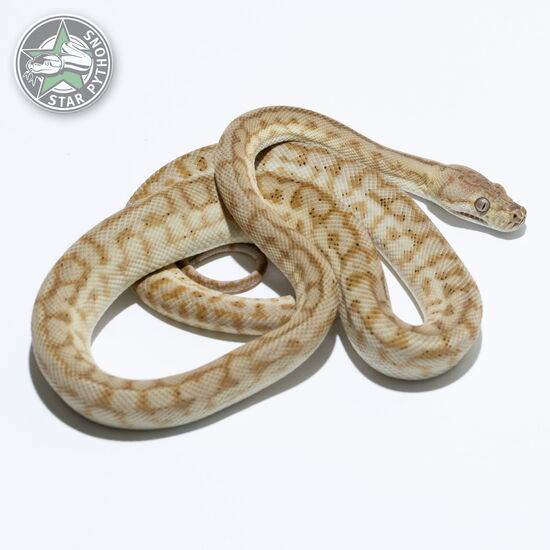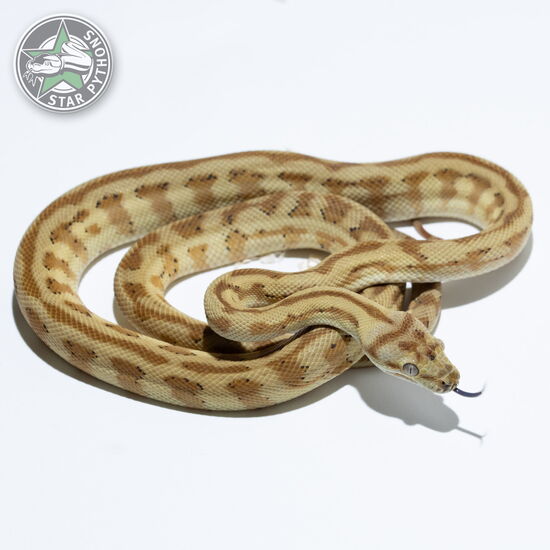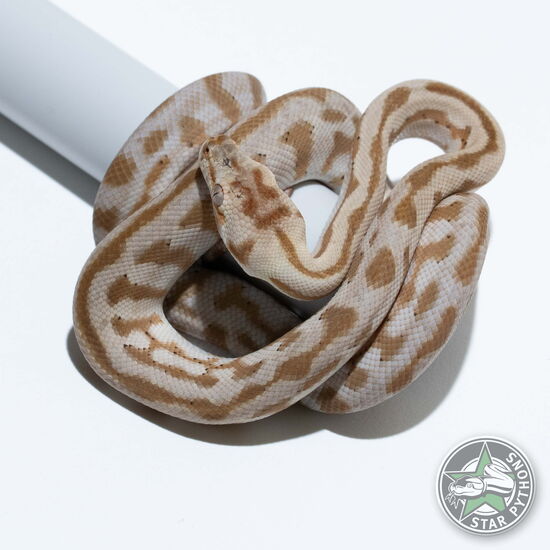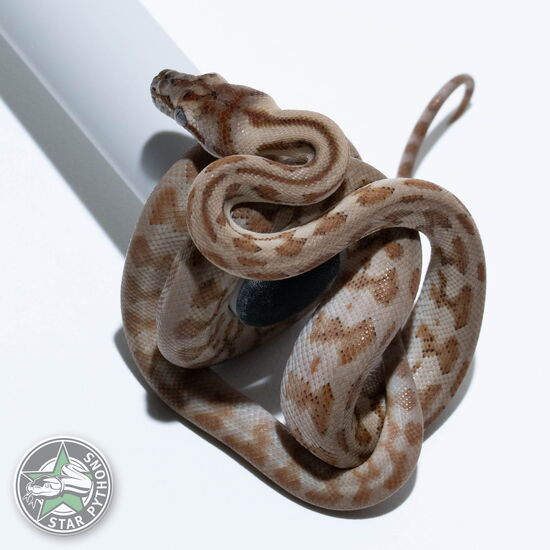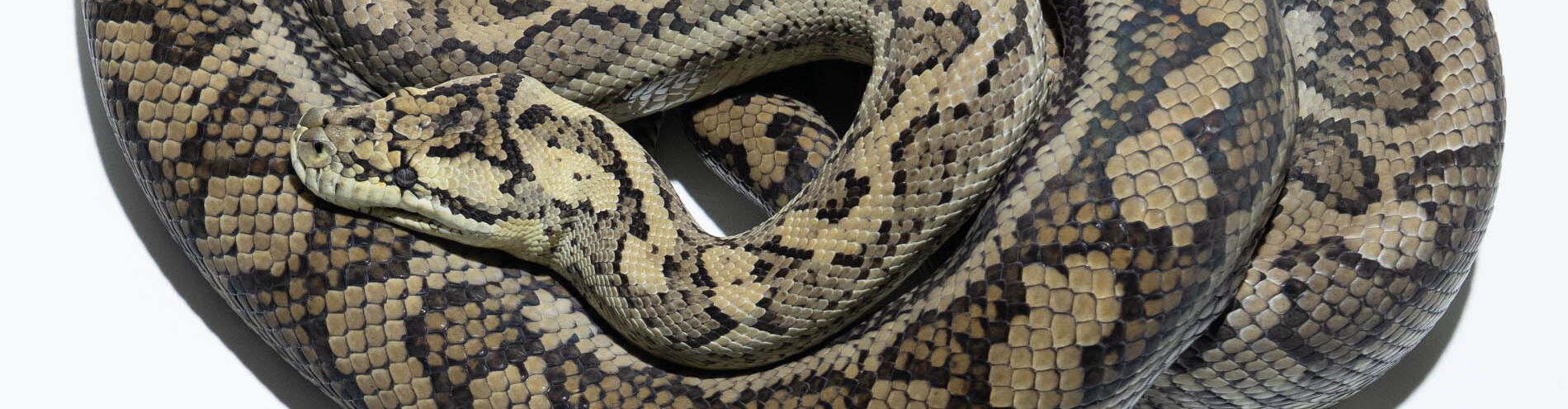
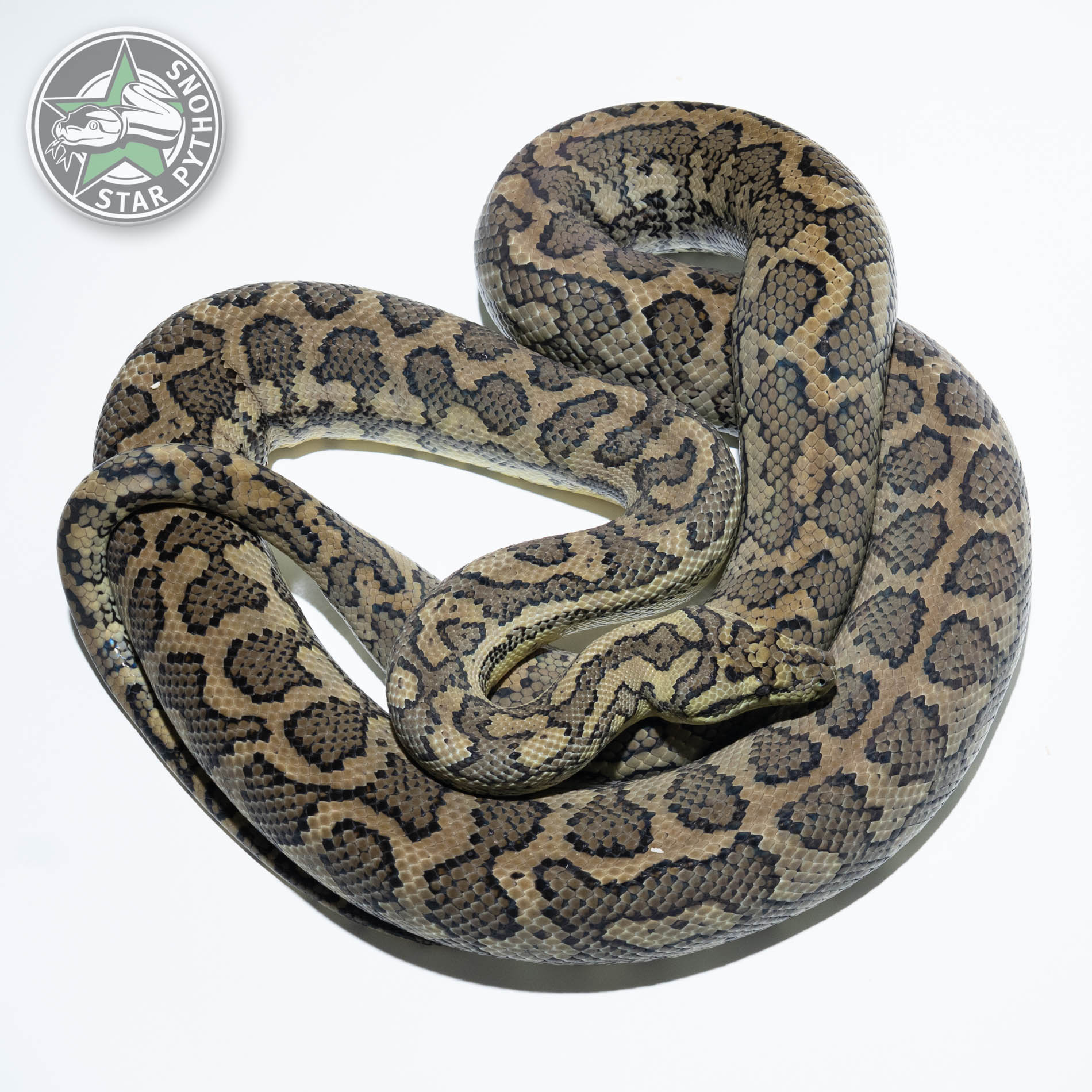
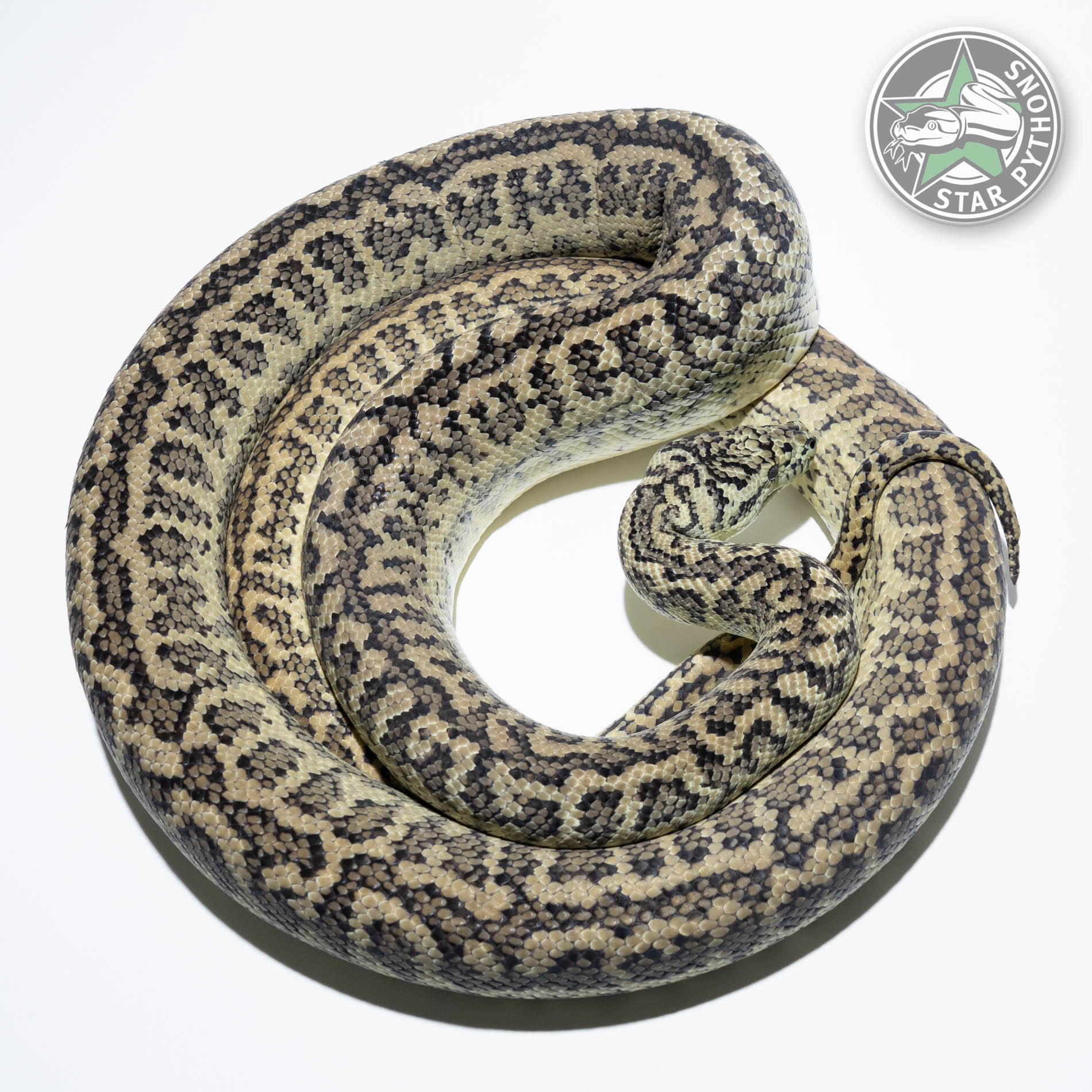
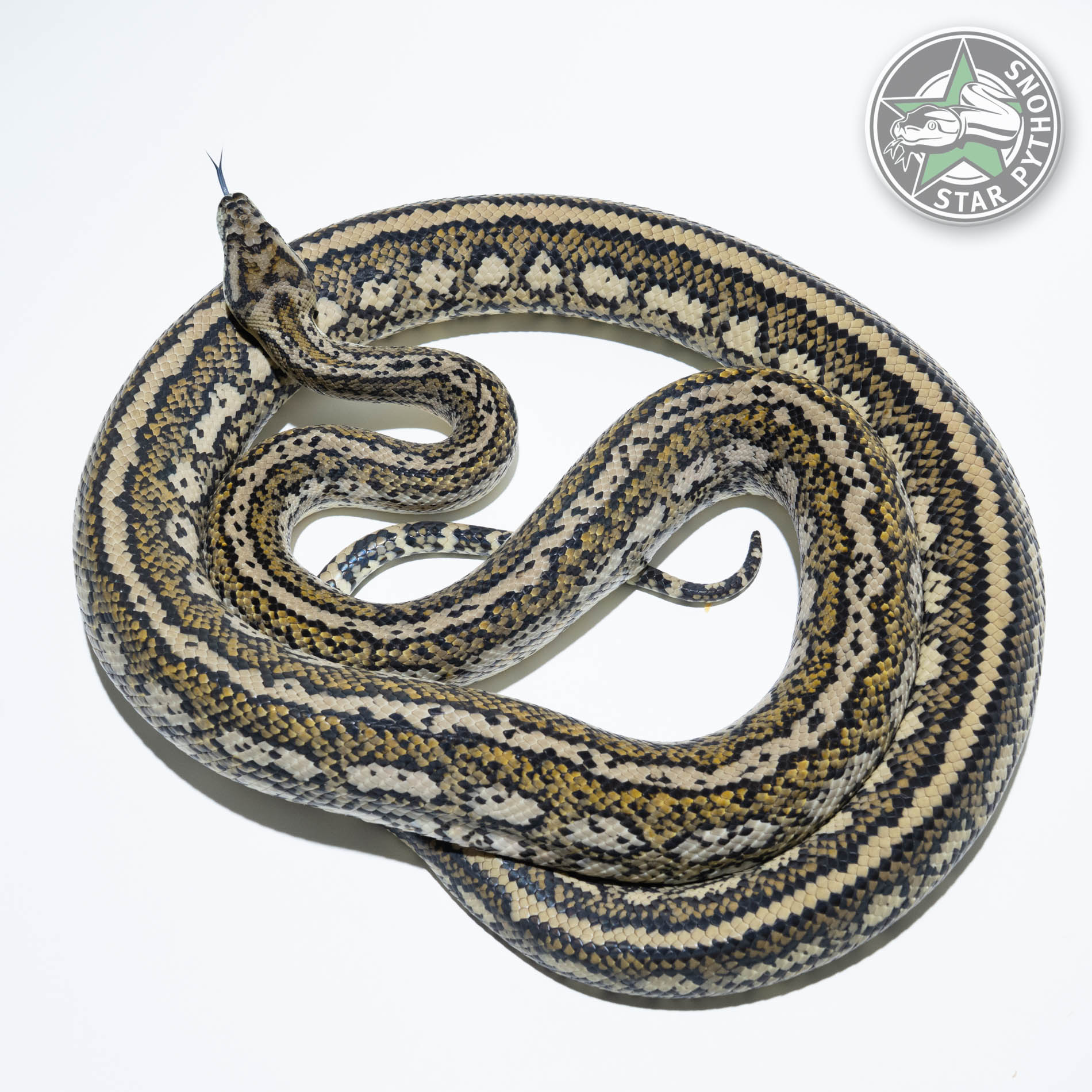
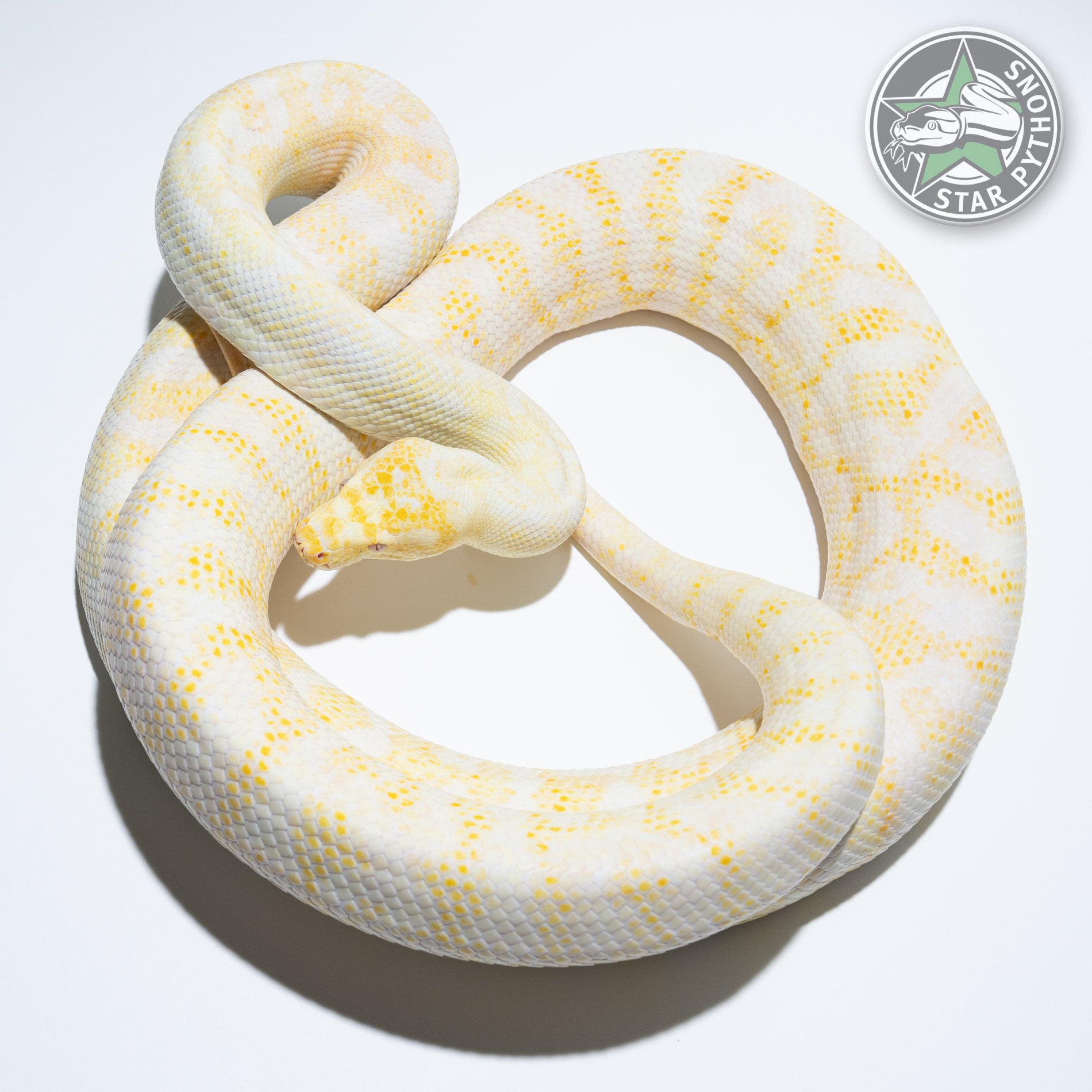
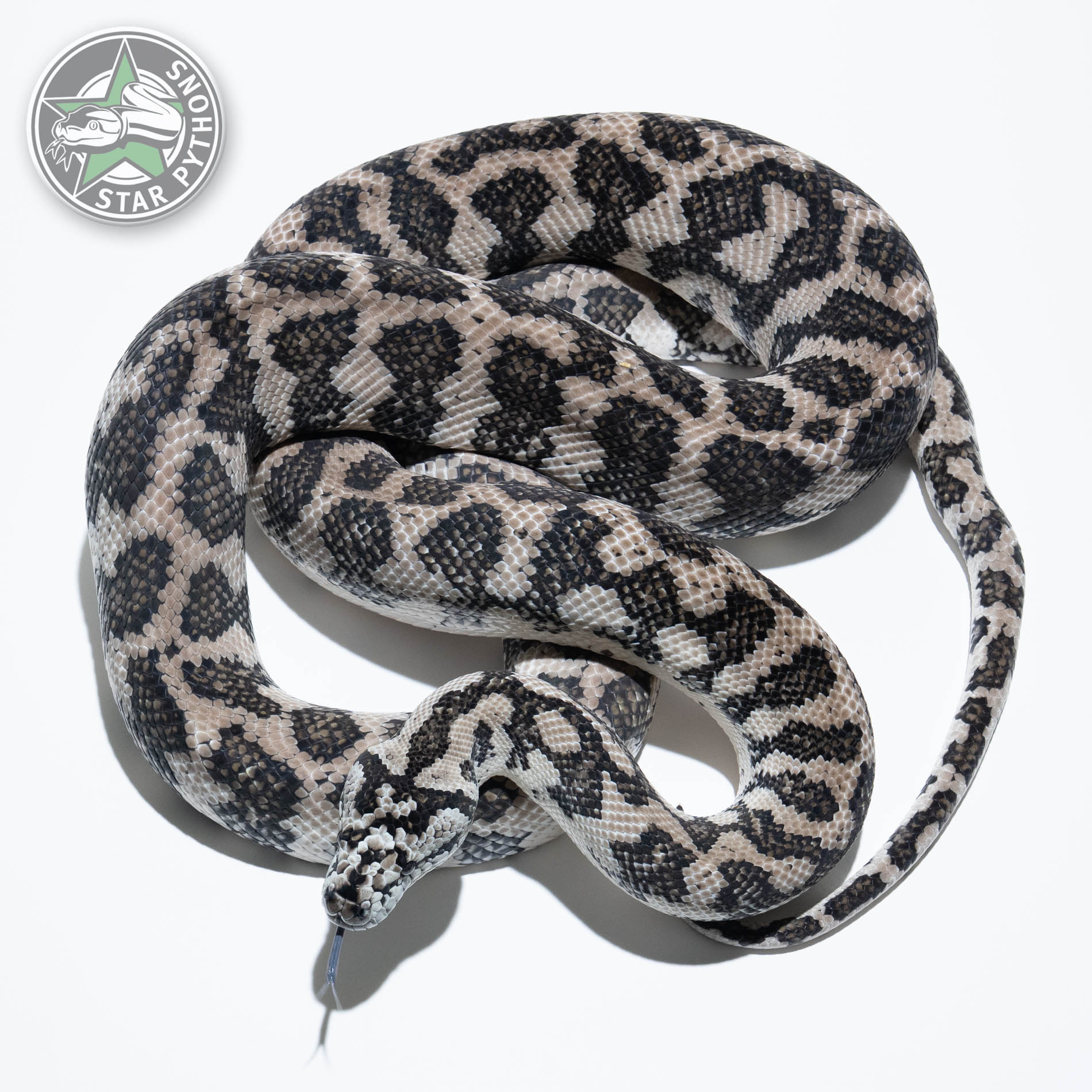
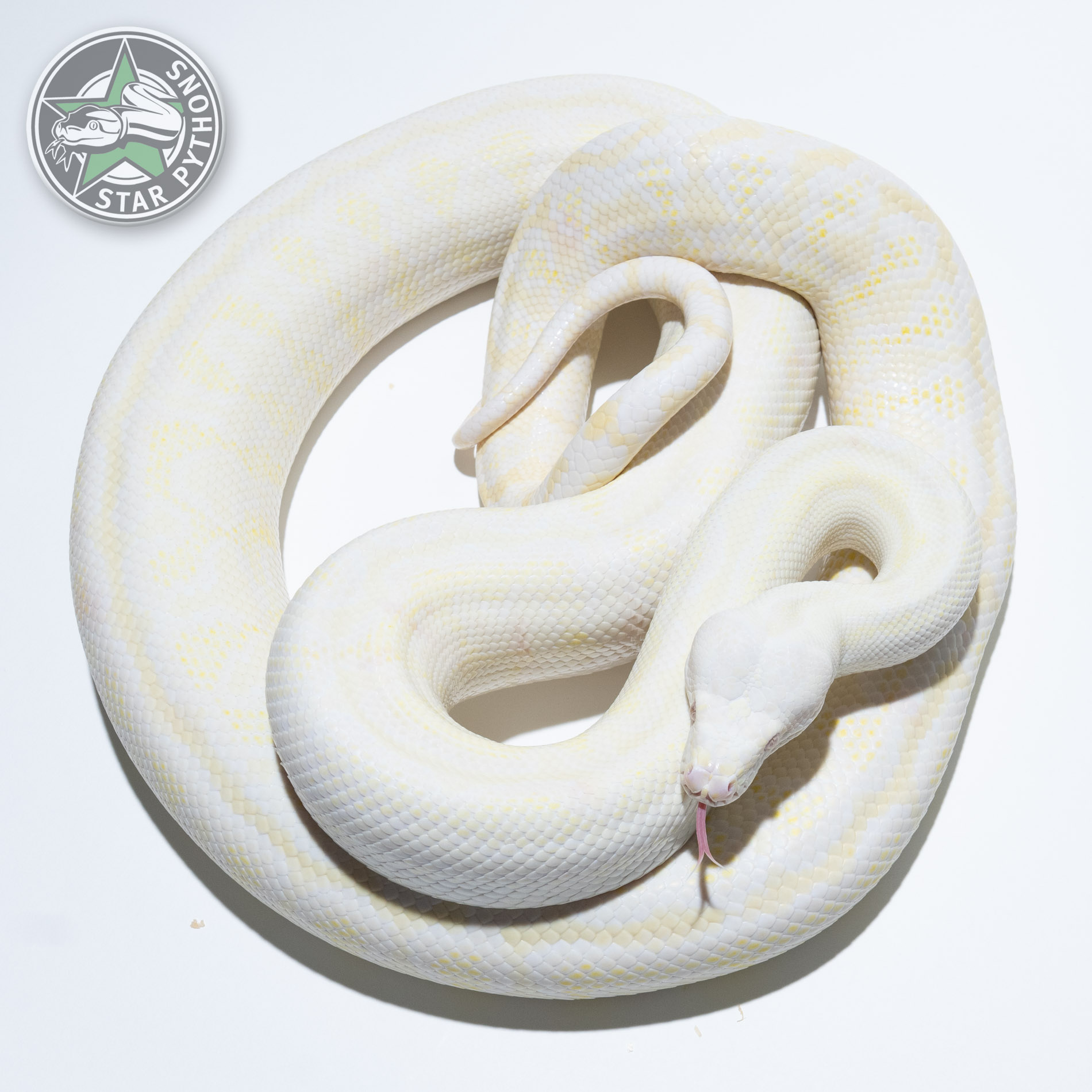
Hypo Carpet Python (Morelia spilota mcdowelli) – pure Coastal hypomelanistic morph with reduced dark pigmentation

Hypo Carpet Pythons: Biology, Genetics & Lines

Hypo Carpet Pythons are Morelia spilota characterised by a partial reduction of melanin – not its complete elimination, but a consistent, heritable brightening of the entire animal. The result is a cleaner, more luminous appearance: darker pigment is reduced rather than removed, leaving warm tones to dominate without completely erasing the original pattern contrast. In adult animals on well-selected lines, the effect can be striking – deep oranges and yellows replacing what would otherwise be olive-brown, with a distinctly cleaner base colour.

This page gives you a practical, breeder-oriented overview: what "hypomelanistic" means biologically, how incomplete dominance works in practice, why the Hypo mutation is the foundation of some of the most sought-after designer morphs in the complex, and what makes a well-documented Hypo line worth seeking out.

Quick link: Scroll down to hypo carpet pythons for sale to see currently available animals.

Hypo Combinations & Gallery

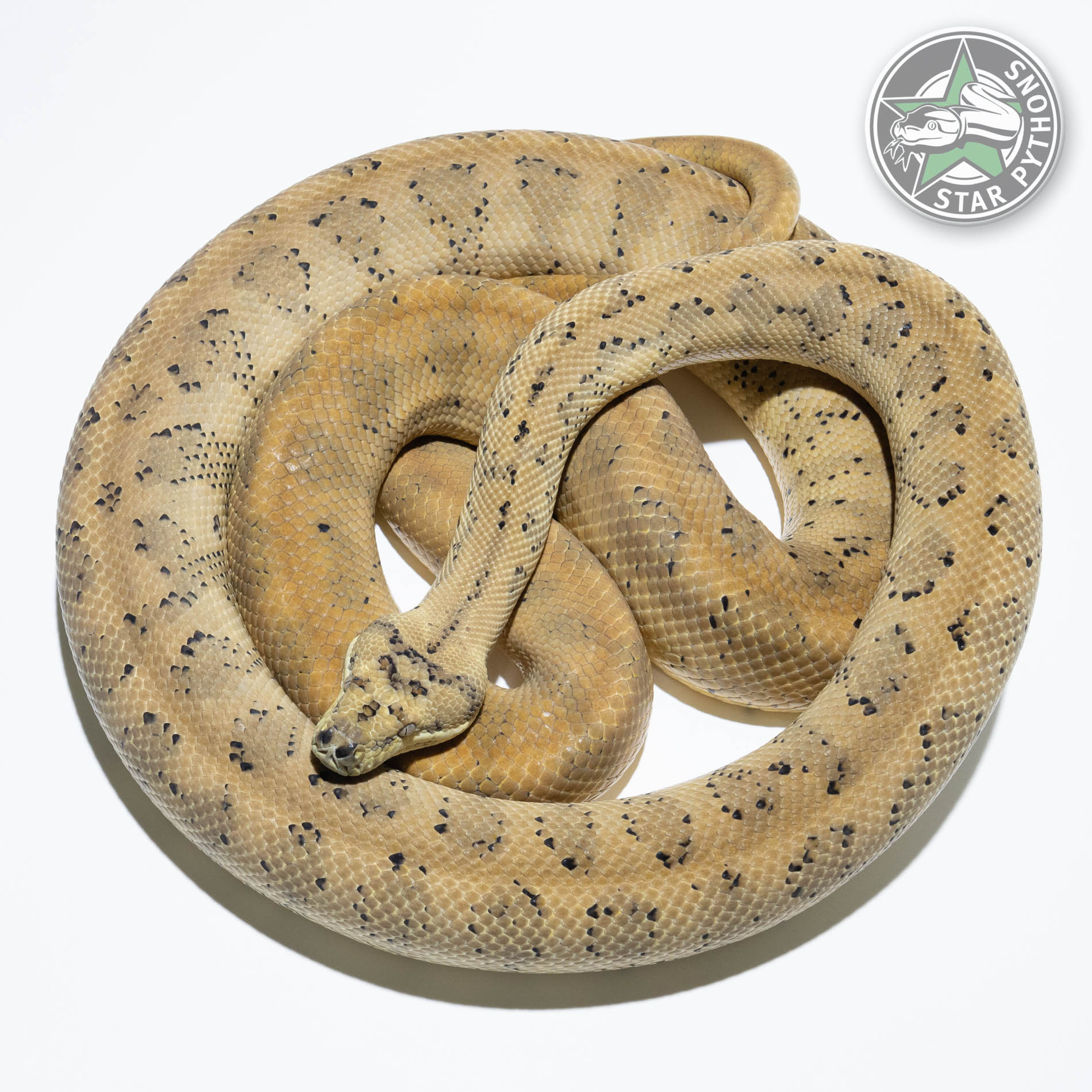
Hypo (pure Coastal)

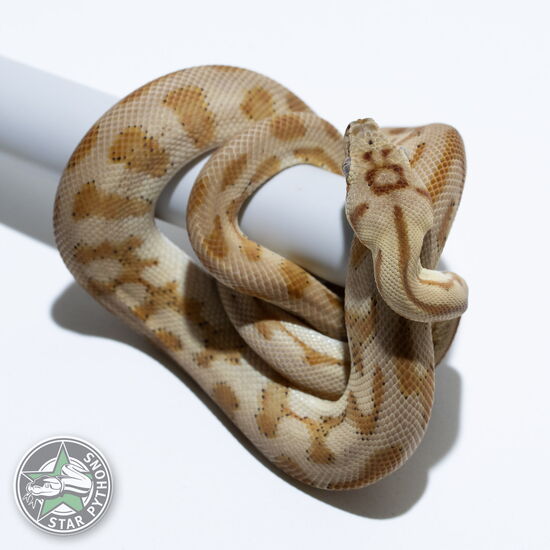
Hypo Carpet Python (Morelia spilota mcdowelli) – pure Coastal hypomelanistic morph with reduced dark pigmentation and warm orange-yellow tones

The Hypo morph originates from Morelia spilota mcdowelli – the Coastal Carpet Python of eastern Australia – and is inherited as an incomplete dominant trait. A single copy of the Hypo allele produces a visually distinct, brightened animal; two copies produce the Super Hypo, a considerably more extreme phenotype with dramatically reduced dark pigment. Neonates hatch a bright orange or red, often with very little visible pattern – one of the most striking neonate appearances in the entire complex. Pigmentation increases after each shed, but this is often minimal, and many animals retain much of their spectacular juvenile colouration into adulthood, resulting in either lemon or orange adults with characteristic green undertones. An important biological note: Hypo affects melanin distribution rather than melanin chemistry. The reduced dark areas on adults still contain true black pigment – there is simply less of it, and it is distributed differently. The degree of melanin reduction varies considerably between individuals, even within the same clutch, making this one of the more phenotypically variable mutations in the complex. Line selection is therefore not just about aesthetics – it is about consistently producing animals at the better end of that natural variation (Mutton & Julander, 2022).

Hypo Jaguar

Hypo Jaguar Carpet Python (Morelia spilota mcdowelli) – double incomplete dominant combination with intensified golden ground colour

The Hypo Jaguar combines two incomplete dominant mutations from the Coastal lineage: Hypo reduces melanin expression and brightens the overall animal, while the Jaguar mutation disrupts and fragments the dorsal pattern into irregular spots and reticulation. Together, the reduced dark pigment of Hypo is projected onto the fragmented pattern canvas of the Jaguar, producing a lighter, higher-contrast animal where warm tones dominate the remaining pattern elements. The Jaguar component is also responsible for neurological effects in homozygous form – Super Jaguar is considered lethal – which is why Jaguar projects are always managed as het × het or visual × het pairings. The Hypo background does not change this; it simply adds another layer of colour impact to an already visually striking combination.

Hypo Zebra

Hypo Zebra Carpet Python (Morelia spilota) – cross-subspecies combination of incomplete dominant Hypo (Coastal) and Zebra (Jungle) with warm-toned banding

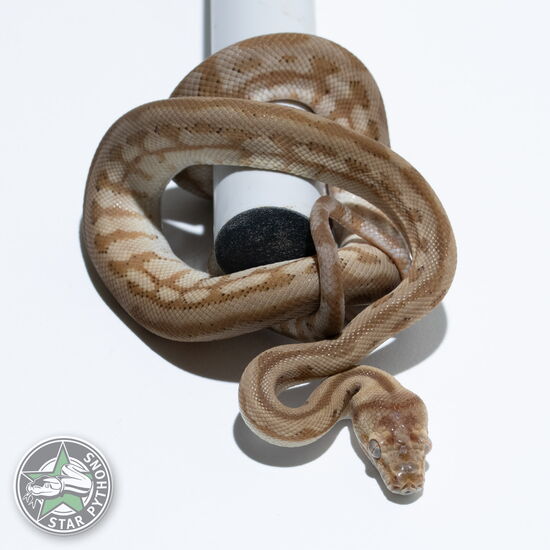
The Hypo Zebra brings together two incomplete dominant mutations from different subspecies: Hypo from Morelia spilota mcdowelli and Zebra from Morelia spilota cheynei. The Zebra mutation produces bold, high-contrast banding with irregular striping; Hypo softens the dark components of that pattern, warming the overall palette and increasing the brightness of both the base colour and the pattern elements. The result is a striking combination where the structural boldness of the Zebra banding is retained, but expressed in cleaner, warmer tones than would be possible with either mutation alone. Because both Hypo and Zebra are incomplete dominant, Super Hypo Zebra animals – carrying two copies of each – are possible in theory, though achieving them requires careful multi-generation planning.

Hypo Tiger

Hypo Tiger Carpet Python (Morelia spilota mcdowelli) – combination of incomplete dominant Hypo with polygenic Tiger striping, clean lateral contrast on warm ground colour

The Hypo Tiger combines the incomplete dominant Hypo mutation with the polygenic Tiger trait – both from Morelia spilota mcdowelli. Tiger is not a single-gene mutation: it describes a tendency toward longitudinal striping along the dorsum that is intensified through selective line breeding across multiple generations. Adding Hypo to a well-selected Tiger line amplifies the visual impact considerably – the reduced melanin allows the warm ground colour to dominate, while the Tiger pattern creates clean lateral contrast. Because Tiger is polygenic, the quality of the Tiger expression depends heavily on the depth of the underlying breeding line; a Hypo Tiger from a well-established project will look markedly different from one produced incidentally. Line selection matters here more than perhaps anywhere else in Hypo breeding.

Sunglow (Hypo Albino)

Sunglow Carpet Python (Morelia spilota) – Hypo Albino combination morph with reduced pattern and warm tones

The Sunglow is the combination of Hypo and the recessive Albino – and it is, in many ways, the purest expression of what the Hypo mutation is capable of when given the right partner. Where Hypo alone reduces melanin, Albino eliminates it entirely; together, the two mechanisms remove virtually all dark pigment, producing an exceptionally pale, warm-toned animal with minimal pattern contrast and a clean, almost glowing appearance. From the Hypo perspective, the Sunglow demonstrates the mutation's core strength: it does not simply lighten an animal – it transforms the colour balance entirely. An important distinction: true Sunglows require the Hypo allele. Caramel Albino animals can look superficially similar but are genetically distinct and should not be labelled as Sunglow. More on the Albino component can be found on our Albino page.

Ghost (Hypo Axanthic)

Ghost carpet python male – Hypo Axanthic (Morelia spilota), hatched 2021 – StarPythons

The Ghost combines the incomplete dominant Hypo with the recessive Axanthic – and the two mutations work in opposite directions in a way that makes the result uniquely compelling. Where Hypo reduces melanin and warms the animal, Axanthic reduces yellow pigment and cools it. The combination produces a muted, smoky animal with reduced contrast in both directions – softer darks, muted yellows – creating the characteristic "ghosted" appearance that gives the morph its name. From the Hypo perspective, the Ghost demonstrates that the mutation is not simply about making animals brighter: paired with Axanthic, it contributes to a deliberate visual restraint that is equally striking in its own way. Note that Ghost is specifically Hypo + Axanthic; Caramel Axanthic combinations are not Ghost and should not be labelled as such. The Axanthic component is covered in detail on our Axanthic page.

Ghost Zebra Jaguar

Ghost Zebra Jaguar carpet python male (Morelia spilota), hatched 2022 – StarPythons

The Ghost Zebra Jaguar is one of the most complex multi-trait combinations in the carpet python complex, bringing together four distinct genetic influences: the incomplete dominant Hypo, the recessive Axanthic (together forming the Ghost base), the incomplete dominant Zebra from Morelia spilota cheynei, and the incomplete dominant Jaguar. The Hypo contribution here is central: it is the melanin-reducing component that gives the Ghost its characteristic muted quality, and it is precisely this warmth-reducing-while-brightening mechanism that, alongside the Axanthic, creates the washed-out, high-contrast ghost effect on the Zebra and Jaguar pattern canvas. The result is a pale, fragmented, and structurally bold animal where each trait amplifies the others. The Axanthic component is described in detail on our Axanthic page.

Moonglow (Hypo Snow)

Moonglow carpet python female – Hypo Albino Axanthic (Morelia spilota), hatched 2022 – StarPythons

The Moonglow is the combination of Hypo with the double recessive Snow (Albino + Axanthic) – and it represents the logical endpoint of the Hypo breeding program when all three pigment-reducing pathways are combined. Snow already eliminates both melanin and yellow pigment, producing a near-white animal with subtle residual contrast; adding Hypo removes the last remaining traces of melanin expression, resulting in an animal that is as close to pure white as the carpet python complex currently allows. The Fullmoon – Super Hypo Snow – takes this one step further, with two copies of the Hypo allele on a Snow background. From the Hypo perspective, the Moonglow illustrates the mutation's ultimate role: not as a standalone colour effect, but as the final amplifier in a triple-mechanism project years in the making. A note on terminology: true Moonglows are Hypo-based; Caramel Snow animals, however similar in appearance, are neither Moonglow nor Fullmoon and should not be labelled as such. The Axanthic and Albino components are described on our Axanthic and Albino pages.

What is Hypomelanism?

In the reptile hobby, "hypo" is short for hypomelanistic – a heritable reduction in melanin production rather than its complete elimination. The distinction matters: where an albino (amelanistic) animal loses the capacity to produce melanin entirely, a hypo animal produces less of it. More precisely, Hypo affects melanin distribution across the body: the melanophore cells remain functional and still produce true black pigment, but the areas in which that pigment is expressed are reduced. The remaining dark areas on an adult Hypo are genuinely black – not faded or diluted – but they occupy less of the body surface than in a normally pigmented animal.

The practical effect is a brightened, cleaner-looking animal. Darker tones shift toward warmer browns and olives; blacks soften in their extent; the overall contrast between pattern and base colour decreases. The warm pigments – yellows and oranges produced by the xanthophores – are not directly affected, which is why hypo animals often appear more saturated in their warm tones: the darker background pigment that would normally mute them is reduced, allowing them to read more clearly. In well-selected lines, adult Hypo Coastal Carpet Pythons develop into lemon or orange animals with characteristic green undertones – a colour profile that is distinctly their own.

The phenotype is highly variable. All Hypos hatch as bright orange or red neonates with minimal visible pattern – a striking starting point – but the degree to which melanin reduction persists into adulthood varies considerably between individuals. Some adults retain much of their vivid juvenile colouration; others develop more pigment with successive sheds. This variability is inherent to the mutation and is precisely why sustained line selection produces meaningfully different results over generations.

Because Hypo is incomplete dominant rather than recessive, the visual effect scales with copy number. A single copy produces a noticeably altered animal. Two copies produce the Super Hypo, where melanin reduction is considerably more extreme: the homozygous expression is a continuation of the trends seen in heterozygotes, pushed further – darker elements are nearly absent, and the animal appears almost entirely in warm, uninterrupted tones with minimal pattern contrast (Mutton & Julander, 2022).

In wild snake populations, conspicuous hypopigmentation is rare precisely because reduced melanin comes with ecological costs – compromised camouflage, increased predation risk, and impaired thermoregulation. As ectotherms, snakes depend on dark pigment for efficient heat absorption from solar radiation; large-scale evidence from Eurasian vipers confirms that darker pigmentation is selectively favoured in cooler, low-radiation environments, implying that hypomelanistic individuals face a measurable thermoregulatory disadvantage in the wild (Martínez-Freiría et al., 2020; Borteiro et al., 2021). In captivity, where temperature, food and shelter are controlled, these selective pressures are removed and the mutation flourishes.

Biology and Genetics

Reptile skin colour is the product of several distinct cell types – collectively called chromatophores – acting in combination. Melanophores produce melanin, supplying the dark browns and blacks that define contrast and pattern structure. Xanthophores produce yellow pigments through pteridines and dietary carotenoids. Erythrophores produce red pigments. Iridophores contain reflective crystalline platelets that scatter and reflect light, contributing optical brightness and iridescence (Beaudier et al., 2025).

In Hypo carpet pythons, the melanophore system remains functional – but melanin output is reduced. The underlying pattern structure is fully intact; the snake still has the same arrangement of lighter and darker scale regions as a normally pigmented animal. What changes is the intensity of the dark component. The key enzyme in melanin synthesis is tyrosinase (TYR), which converts the amino acid tyrosine into the precursors from which melanin is assembled. In hypomelanistic squamates, the current evidence points not to a defective TYR enzyme, but to a regulatory change: TYR is expressed at a lower level than in wild-type animals, meaning the enzyme is produced in smaller quantities and therefore less melanin is synthesised. The molecular machinery works – it simply runs at reduced capacity. For Morelia spilota specifically, this mechanism has not yet been characterised at the level of a specific genetic variant, but the pattern documented in closely related squamates makes an analogous regulatory mechanism highly plausible (Beaudier et al., 2025).

The warm colours that become so prominent in Hypo animals are not produced by the Hypo mutation itself: xanthophore activity is unchanged. The apparent increase in yellow and orange saturation is the result of reduced competition from dark melanin pigment. In a normally pigmented Coastal Carpet Python, melanin distributed across the skin absorbs and masks warm-wavelength light; with less melanin present, the same xanthophore-derived colours read with greater visual intensity. Hypo does not make the animal lighter in a simple sense – it shifts the balance between dark and warm pigment, allowing colours that were always present to dominate. This optical interaction is what gives well-bred Hypo lines their characteristic luminous quality.

The dose-dependent nature of incomplete dominance means that breeding outcomes are predictable in a different way than for recessive traits. A single-copy Hypo animal produces 50 % Hypo and 50 % Super Hypo offspring when paired with another visual Hypo. No non-visual carriers exist in the classic recessive sense; every animal with one copy shows the phenotype. This makes the mutation highly visible in a collection and straightforward to propagate – but it also means that the Super Hypo is a natural and frequent product of Hypo × Hypo pairings, not a rare outcome requiring multi-generation planning.

Inheritance: Practical Expectations

Hypo is inherited as an incomplete dominant trait – meaning that one copy of the allele produces a visual effect, and two copies produce a distinctly different, more extreme phenotype. This contrasts with recessive traits like Albino, where one copy produces no visible change at all.

Three genotypic categories arise in practice:

  • Super Hypo: homozygous – carries two copies of the Hypo allele; produces the most extreme phenotype, with near-complete absence of visible dark melanin and a strongly intensified warm tone across the body
  • Hypo (visual): heterozygous – carries one copy; produces a clearly brightened, visually distinct animal with reduced but not eliminated dark pigment
  • Normal: carries no copies; wild-type pigmentation, visually indistinguishable from any other normally pigmented Coastal

The standard pairing outcomes follow directly from these categories:

  • Hypo × Hypo → statistically 25 % Super Hypo, 50 % Hypo, 25 % Normal. Because visual Hypos and Normals are clearly distinguishable, all offspring can be sorted phenotypically with confidence.
  • Super Hypo × Normal → 100 % Hypo. All offspring carry one copy and are visual, but none are Super.
  • Super Hypo × Hypo → 50 % Super Hypo and 50 % Hypo.
  • Super Hypo × Super Hypo → all offspring Super Hypo.
  • Hypo × Normal → 50 % Hypo and 50 % Normal.

The practical takeaway: because Hypo is visible in every carrier, there are no hidden het animals to track. Line quality – the depth of warm-tone saturation in a well-selected Hypo line – depends on consistent selective breeding over generations, not just the presence of the allele. A Hypo from a carefully selected line of vibrant, well-documented animals will look noticeably different from one produced incidentally in a multi-generational hybrid project.

FAQ - Hypo Carpet Pythons

Why does line quality matter so much for Hypo animals?

Because the Hypo allele defines what the mutation does, but not how well it does it. Within the incomplete dominant framework, the expression of Hypo – the degree of warm-tone saturation, the depth of colour, the visual impact in adults – varies considerably depending on the background genetics of the animal's lineage. A Hypo from a line that has been selectively bred for vivid orange and clean warm tones over many generations will look strikingly different from a Hypo produced incidentally in a project that never prioritised colour intensity. The allele is the same; the result is not. This is why documentation of breeding history and the opportunity to evaluate parent animals matters when acquiring Hypos intended for serious projects.

Does the Hypo mutation affect health or behaviour?

No – the Hypo mutation affects pigmentation only. Hypo carpet pythons eat, thermoregulate, reproduce, and behave identically to normally pigmented animals. There is no light sensitivity (unlike in Albino animals, where unpigmented irises affect light regulation), no neurological association, and no known fitness cost. Super Hypos are equally robust. The mutation is one of the most straightforward in the complex from a husbandry perspective: the only meaningful difference is visual.

What is a Ghost, and why does it have to be Hypo-based?

Ghost is the established name for the combination of Hypo (incomplete dominant, Coastal) and Axanthic (recessive, IJ/Papuan or Coastal). The name reflects the muted, washed-out appearance that results when reduced melanin and reduced yellow pigment act together: neither bright nor dark, but characteristically pale and understated. The term "Ghost" is specifically associated with the Hypo component; Caramel Axanthic combinations produce a similar visual effect through different genetic means and should not be labelled as Ghost. The two are not interchangeable in a breeding program. A Caramel Axanthic × Hypo Axanthic pairing will not produce visual Ghosts – the alleles are at different loci.

What is the difference between a Sunglow and a Caramel Albino?

Both Sunglow and Caramel Albino are pale, warm-toned carpet pythons – but they are genetically distinct and not interchangeable. Sunglow is Hypo + Albino: the incomplete dominant Hypo from Morelia spilota mcdowelli combined with the recessive Albino. Caramel Albino is Caramel + Albino: the incomplete dominant Caramel mutation combined with the same Albino allele. Crucially, Hypo and Caramel are entirely separate mutations occurring at different loci – they are not alleles of the same gene, and no amount of crossbreeding will convert one into the other. The two combinations can look superficially similar, particularly in photographs, but they carry fundamentally different genetic content. Labelling one as the other is a meaningful error in any breeding program, and the phenotypic differences between Super Hypo and Super Caramel – illustrated clearly in Mutton & Julander (2022) – make the distinction visually apparent once you know what to look for.

What is the difference between a Moonglow and a Fullmoon?

Moonglow is Hypo + Snow (Albino + Axanthic) – one copy of the Hypo allele on a double recessive Snow background. Fullmoon is Super Hypo + Snow – two copies of the Hypo allele on the same Snow background. Both produce near-white animals with minimal residual contrast; the Fullmoon is the more extreme phenotype, with the additional Hypo copy reducing the last traces of melanin expression that can still be visible in a Moonglow. Both terms refer specifically to Hypo-based combinations; Caramel Snow animals, however similar in appearance, are neither Moonglow nor Fullmoon and should not be labelled as such.

What is a Super Hypo, and how is it different from a visual Hypo?

Super Hypo describes an animal homozygous for the Hypo allele – carrying two copies rather than one. Because Hypo is incomplete dominant, the phenotype scales with copy number: a single copy produces a visually distinct, brightened animal with reduced but not eliminated dark pigment; two copies produce a considerably more extreme result, where dark melanin is nearly absent and the warm tones dominate almost completely. The Super Hypo is not a separate mutation – it is the homozygous form of the same allele. It arises naturally from Hypo × Hypo pairings at a rate of 25% per clutch.

Is Hypo the same as Albino?

No – Hypo and Albino are fundamentally different mutations. Albino (amelanistic) eliminates melanin production entirely through a loss-of-function mutation in the melanin synthesis pathway; Hypo reduces it. An Albino animal has no functional melanin production; a Hypo animal produces melanin, just less of it. The visual result of both mutations is a brighter, warmer animal – but the degree and mechanism differ. Albino produces the more dramatic effect; Hypo produces a more graduated one that scales with copy number. The two mutations can also be combined: Sunglow (Hypo Albino) stacks both effects simultaneously, eliminating melanin while adding the brightening influence of Hypo on top.

If Hypo and Albino both involve the same enzyme, why do they look so completely different?

It is a fair question – a Hypo and an Albino look like they belong to entirely different categories. One is a warm, luminous orange or lemon animal; the other is almost white or pale yellow with no dark pigment whatsoever. Yet both, at a molecular level, involve the tyrosinase enzyme (TYR) and its role in melanin synthesis. How can the same gene produce such different outcomes?

The answer lies in the distinction between how much of something works and whether it works at all. In hypomelanistic animals, the evidence from squamate research points to a regulatory change: TYR is expressed at a reduced level, meaning the enzyme is produced in smaller quantities and less melanin is made – but the process itself continues. The melanophores still function, still produce true black pigment, just less of it. The result is a dampened dark component, which allows the warm colours produced by xanthophores – the yellows and oranges that were always there in the skin – to emerge more strongly. Hypo does not create new colour; it removes the dark overlay that was suppressing it.

In an albino (amelanistic) animal, the situation is fundamentally different: the TYR enzyme itself is non-functional. It cannot convert tyrosine into melanin precursors at all. The result is not reduced melanin but the complete absence of it. With nothing left to suppress the warm pigments, they read with full, unimpeded intensity – which is why Albinos look so dramatically pale and bright rather than simply "less dark".

So the difference is not just one of degree. Hypo is a regulatory change – less of a working process. Albino is a functional loss – a process that no longer works. Same gene, same pathway, fundamentally different mechanism, and a visual result that reflects that difference precisely. The combination of both – Sunglow – stacks the two mechanisms: reduced melanin production from Hypo, combined with the complete inability to produce melanin from Albino, resulting in an animal where both effects reinforce each other (Beaudier et al., 2025; Mutton & Julander, 2022).
References

Beaudier, P., Ullate-Agote, A., & Tzika, A. C. (2025). Candidate genes underlying hypomelanistic morphs in squamate reptiles. Genetics, 232(1), iyaf236. https://doi.org/10.1093/genetics/iyaf236

Borteiro, C., Abegg, A. D., Oda, F. H., Cardozo, D., Kolenc, F., Etchandy, I., Bisaiz, I., Prigioni, C., & Baldo, D. (2021). Aberrant colourations in wild snakes: Case study in Neotropical taxa and a review of terminology. Salamandra, 57(1), 124–138.

Martínez-Freiría, F., Toyama, K. S., Freitas, I., & Kaliontzopoulou, A. (2020). Thermal melanism explains macroevolutionary variation of dorsal pigmentation in Eurasian vipers. Scientific Reports, 10, 16122. https://doi.org/10.1038/s41598-020-72871-1

Mutton, N., & Julander, J. (2022). The more complete carpet python: A comprehensive guide to the natural history, care, and breeding of the Morelia spilota complex. ECO Publishing. ISBN 978-1-938850-42-4.

Available Hypo Carpet Pythons for Sale

Sex
Category
Morph
This beautiful female Hypo carpet python with id 24-096 is for sale.
Animal ID: 24-096

Hypo

600 € US$ 800 ₩ 1,199,000

Details

This beautiful male Ghost carpet python with id 24-067 is for sale.
Animal ID: 24-067

Ghost

1.800 € US$ 1,900 ₩ 2,599,000

Details

This beautiful female Sunglow Jaguar carpet python with id 24-049 is for sale.
Animal ID: 24-049

Sunglow Jaguar

1.600 € US$ 2,100 ₩ 3,099,000

Details

This beautiful male Ghost carpet python with id 25-147 is for sale.
Animal ID: 25-147

Ghost

1.800 € US$ 1,900 ₩ 2,599,000

Details

This beautiful male Hypo Zebra Jaguar carpet python with id 23-916 is for sale.
Animal ID: 23-916

Hypo Zebra Jaguar

900 € US$ 1,300 ₩ 1,499,000

Details

This beautiful female Hypo Zebra carpet python with id 23-486 is for sale.
Animal ID: 23-486

Hypo Zebra

600 € US$ 900 ₩ 1,299,000

Details