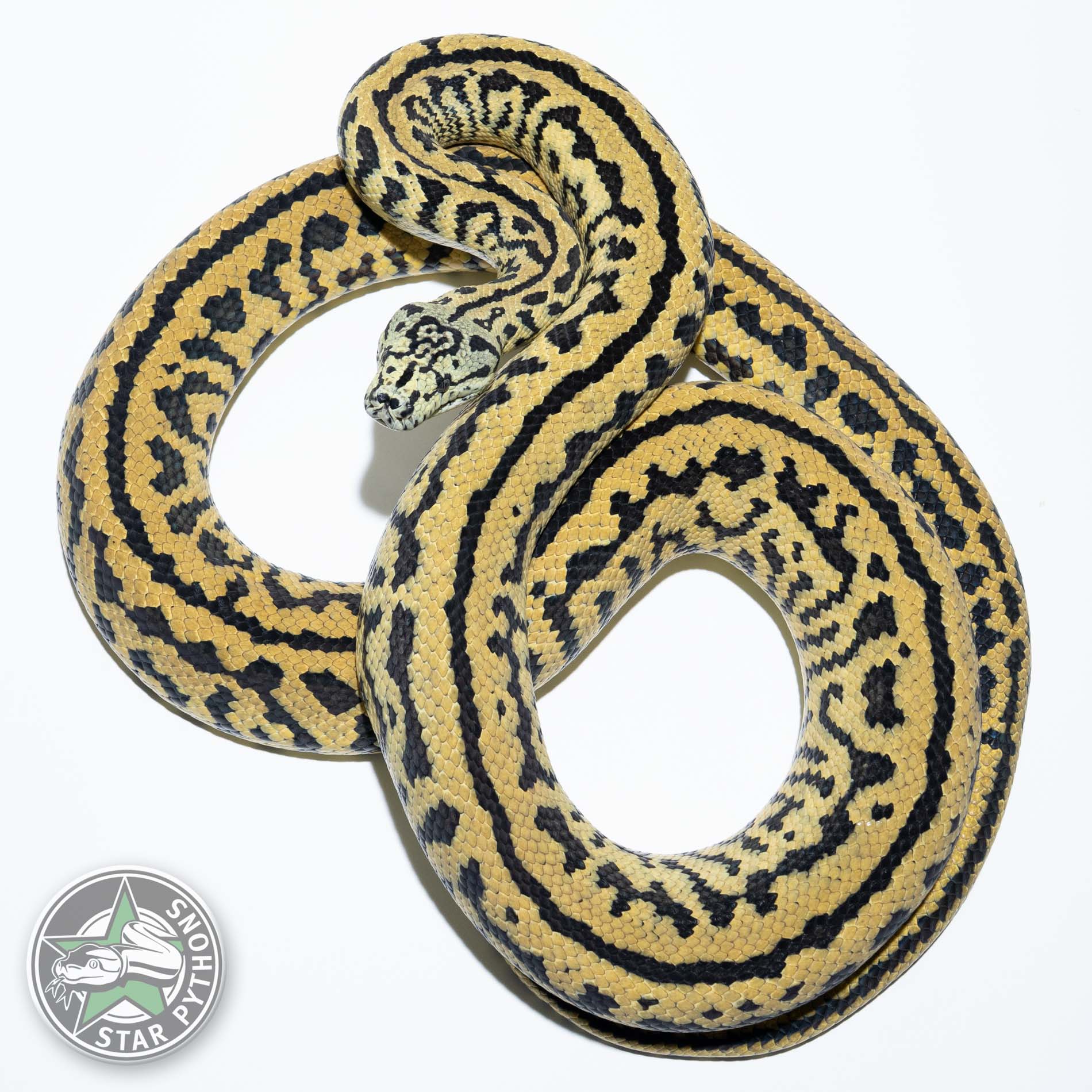
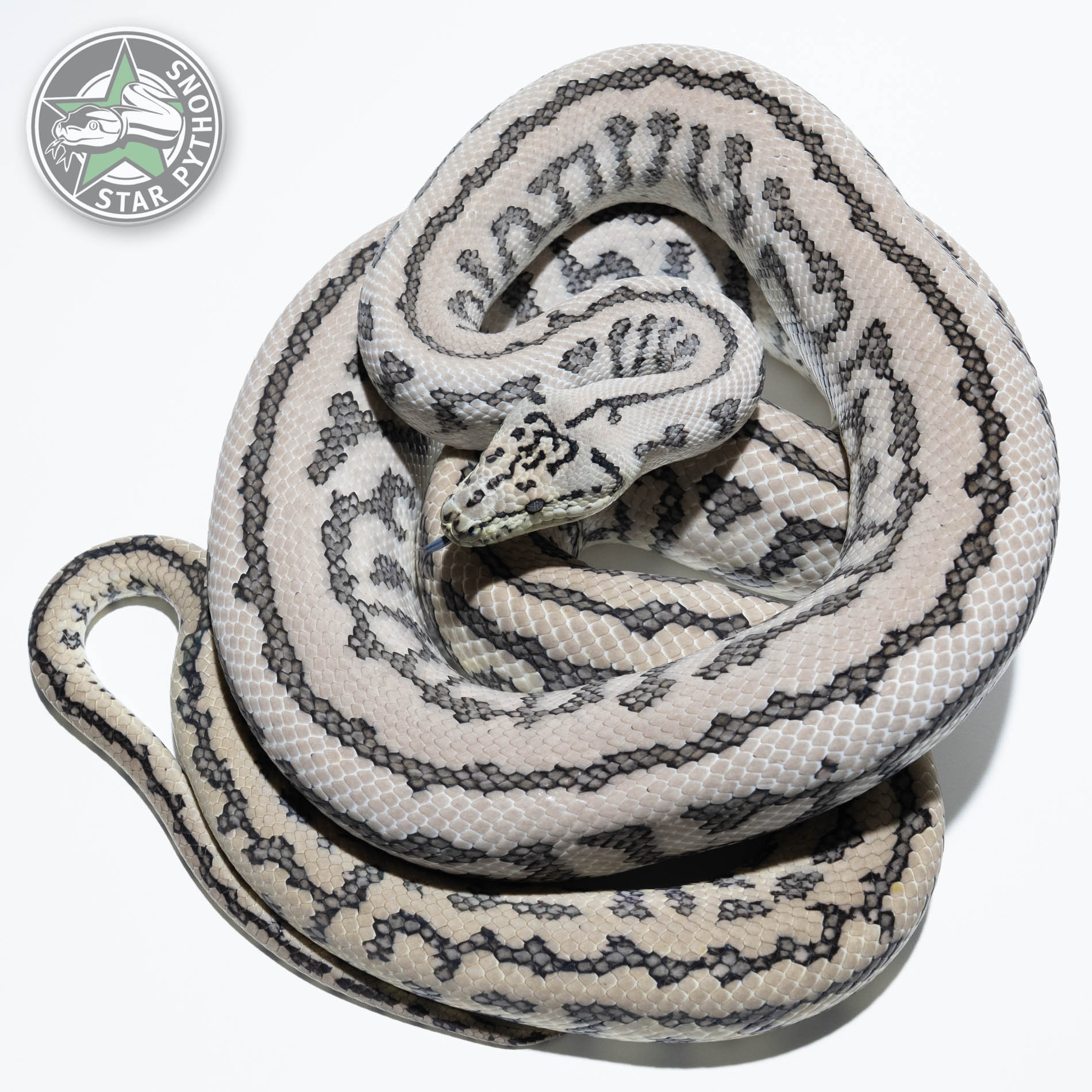
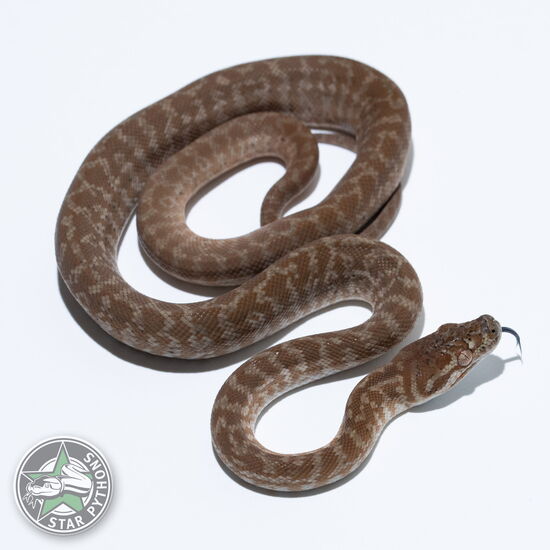
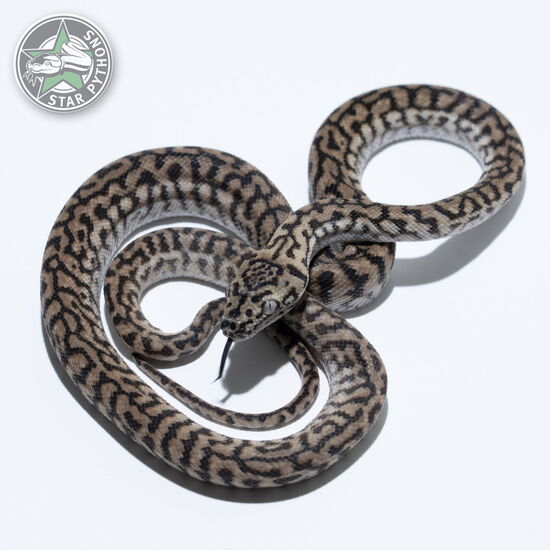
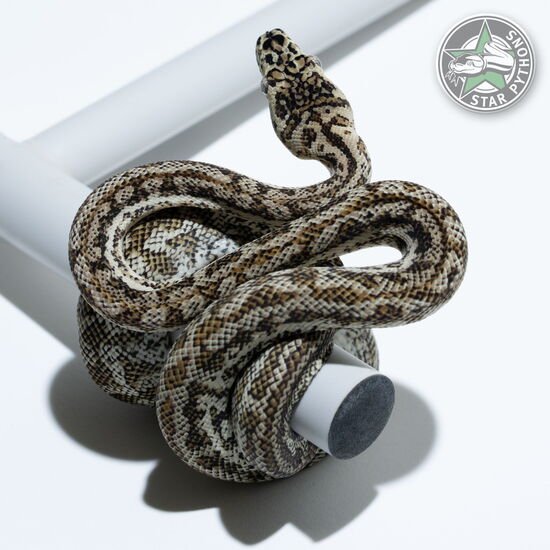
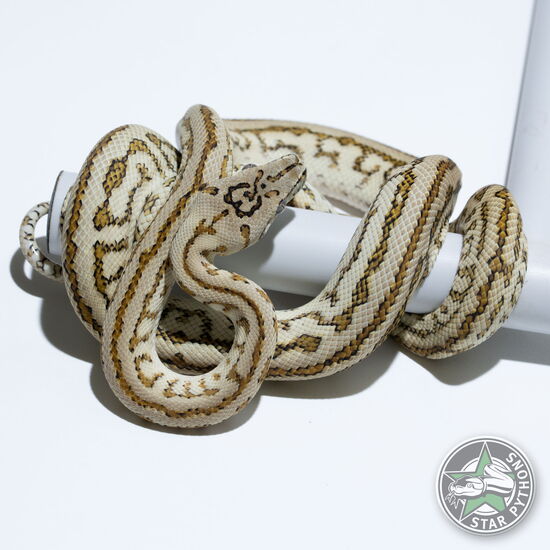
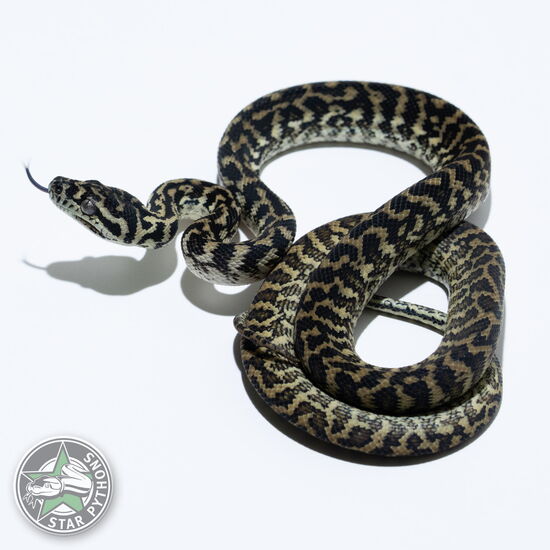
German Bloodline Zebra Carpet Python (Morelia spilota cheynei) – pure Jungle Zebra with high-contrast black and yellow banding from the StarPythons German Bloodline

Zebra Carpet Pythons: Genetics, Lines & Appearance

Zebra Carpet Pythons are Morelia spilota characterised by a bold, intricate banding pattern that replaces the typical irregular markings of wild-type Jungle Carpet Pythons. The mutation originated in Morelia spilota cheynei and is intermediately inherited – meaning it has a visible heterozygous form (Zebra) and a homozygous "super" form (Super Zebra), which appears as a patternless animal. Zebra is among the most popular and versatile pattern morphs in the carpet python complex, combining effectively with colour mutations like Caramel, Albino, Axanthic, and Jaguar to produce some of the most visually striking designer animals available.

This page gives you a practical, breeder-oriented overview: what defines the Zebra pattern, how the intermediate inheritance works in practice, where the morph originated, and how Zebra combines with other traits to create well-known morph combinations.

Quick link: Scroll down to zebra carpet pythons for sale to see currently available animals.

Zebra Combinations & Gallery

German Bloodline Zebra (pure Jungle)

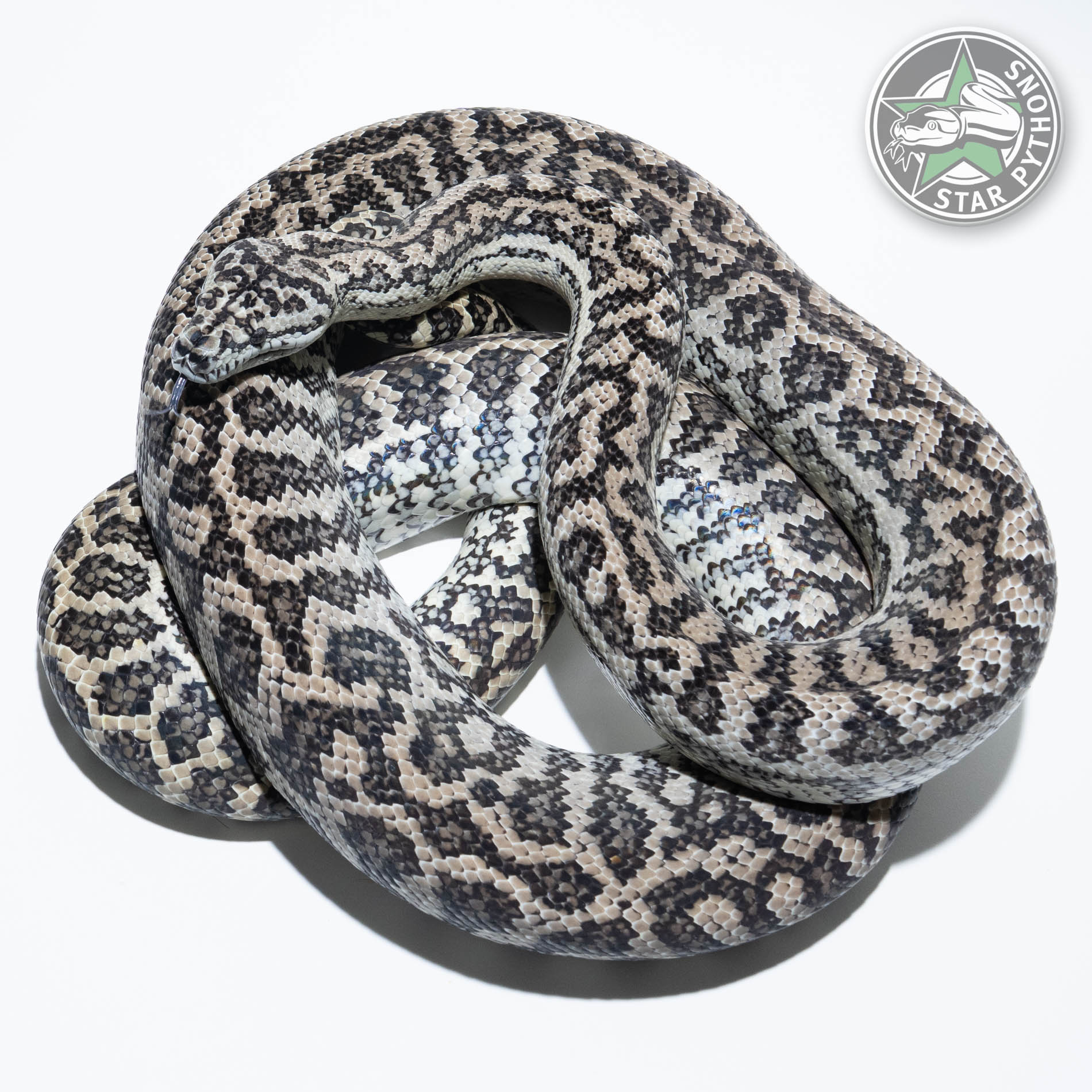
German Bloodline Zebra Carpet Python (Morelia spilota cheynei) – pure Jungle Zebra with high-contrast black and yellow banding from the StarPythons German Bloodline

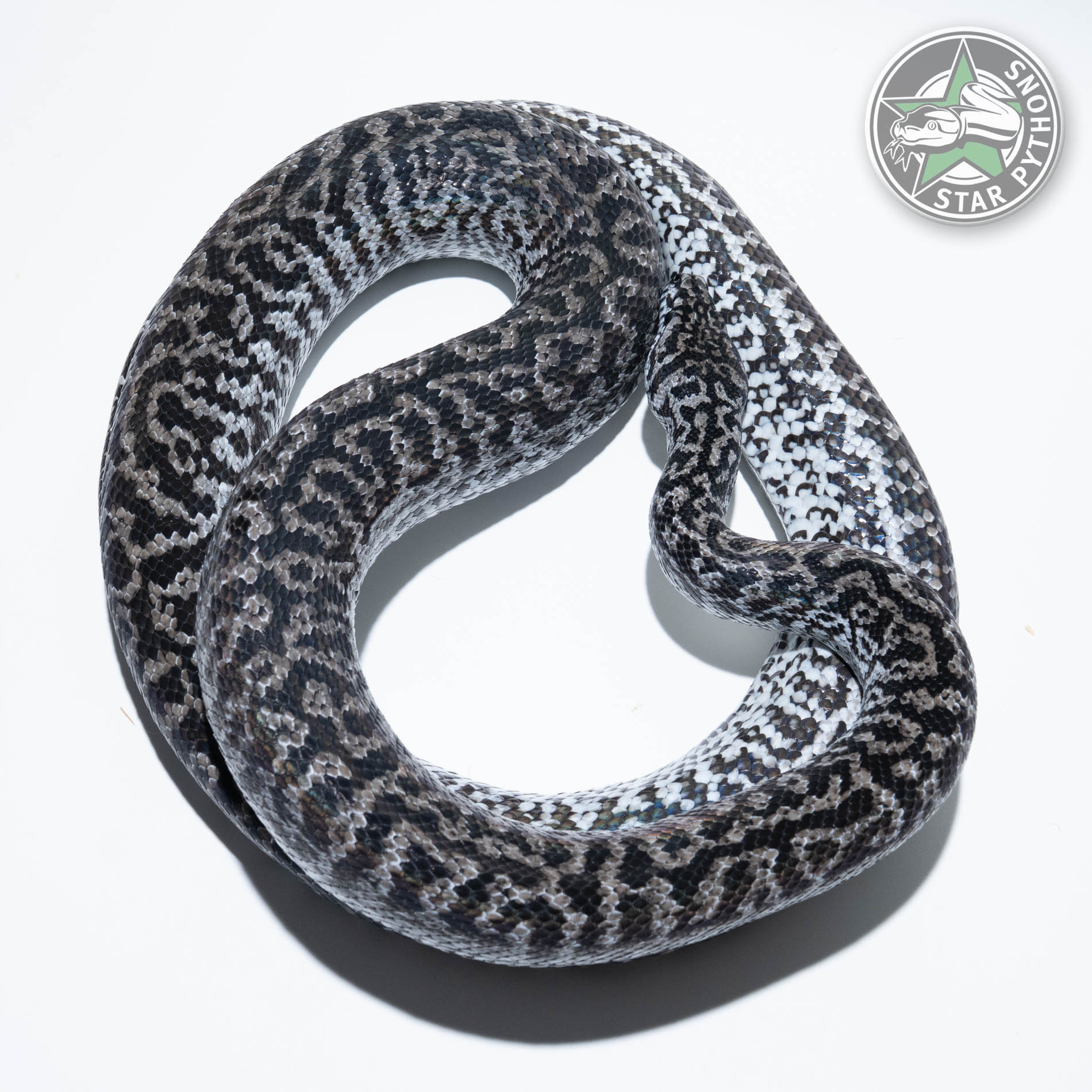
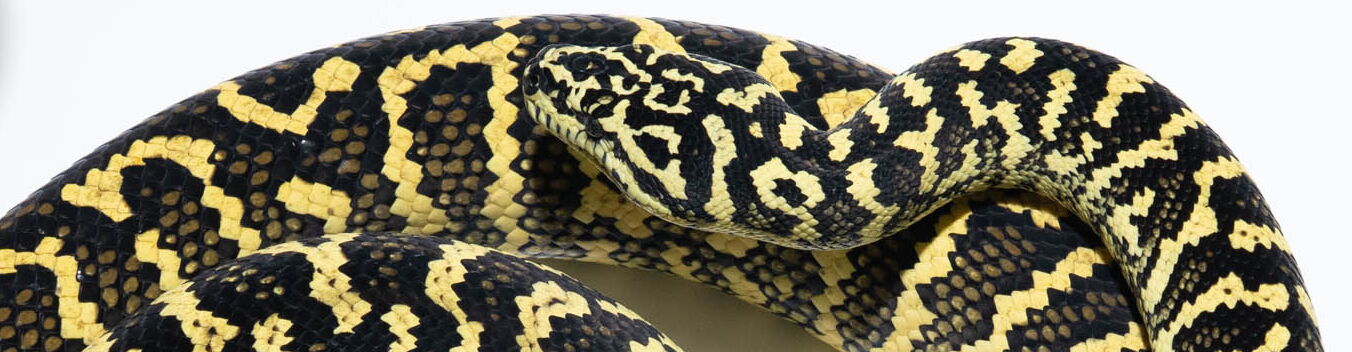
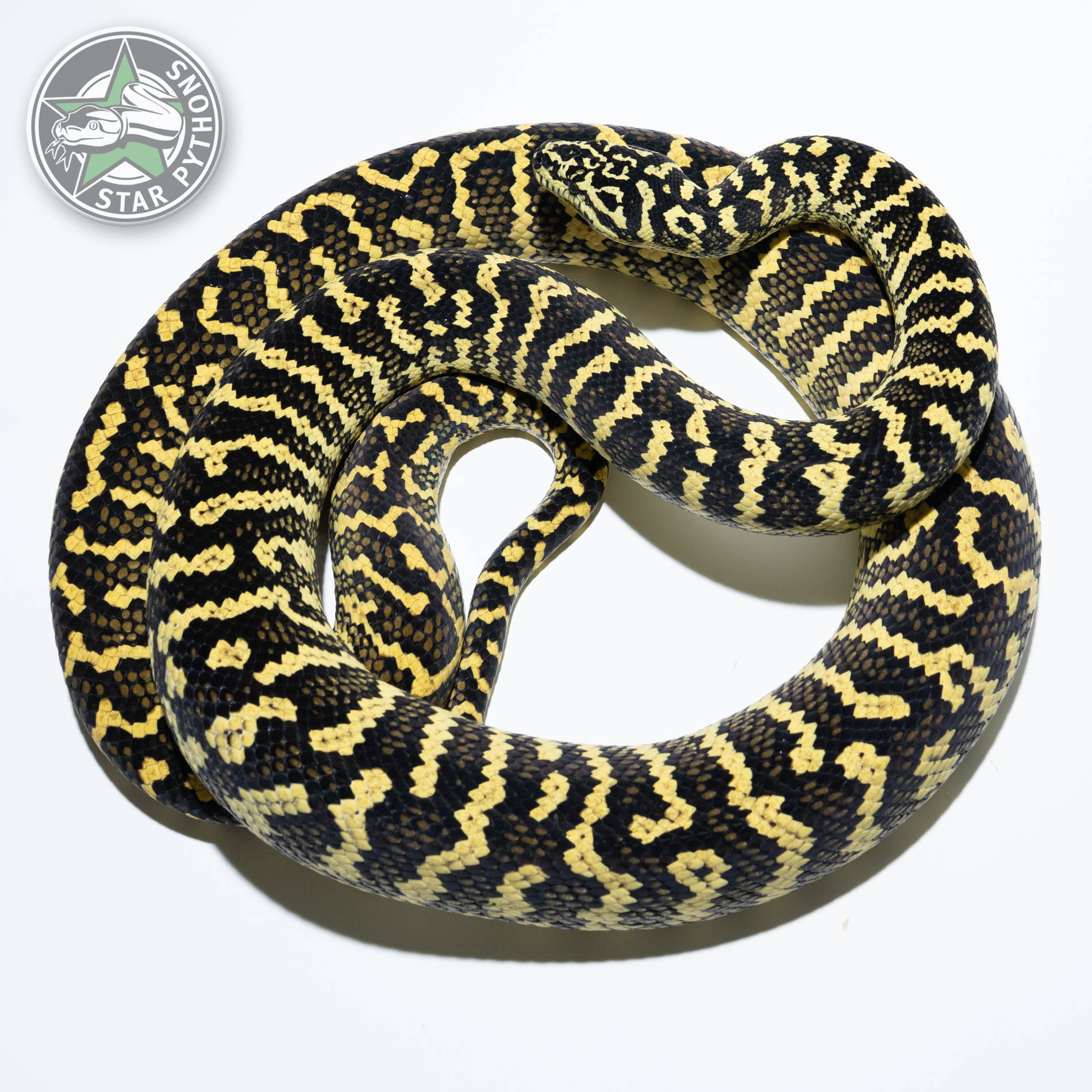
The German Bloodline Zebra is a pure Jungle Carpet Python (Morelia spilota cheynei) carrying one copy of the Zebra allele, bred within our documented German Bloodline programme. The German Bloodline is known for exceptionally deep black pigmentation and vivid yellow contrast – qualities that elevate the Zebra pattern from merely interesting to genuinely striking. Where Zebras from less selectively bred backgrounds can appear muted or washed out as adults, German Bloodline Zebras retain their crisp, high-contrast banding well into maturity. The fine transverse striping characteristic of the morph is displayed at its best against this intensely pigmented background. As a pure cheynei animal with full lineage documentation, this combination represents the Zebra morph in its original subspecies context.

Zebra Jaguar

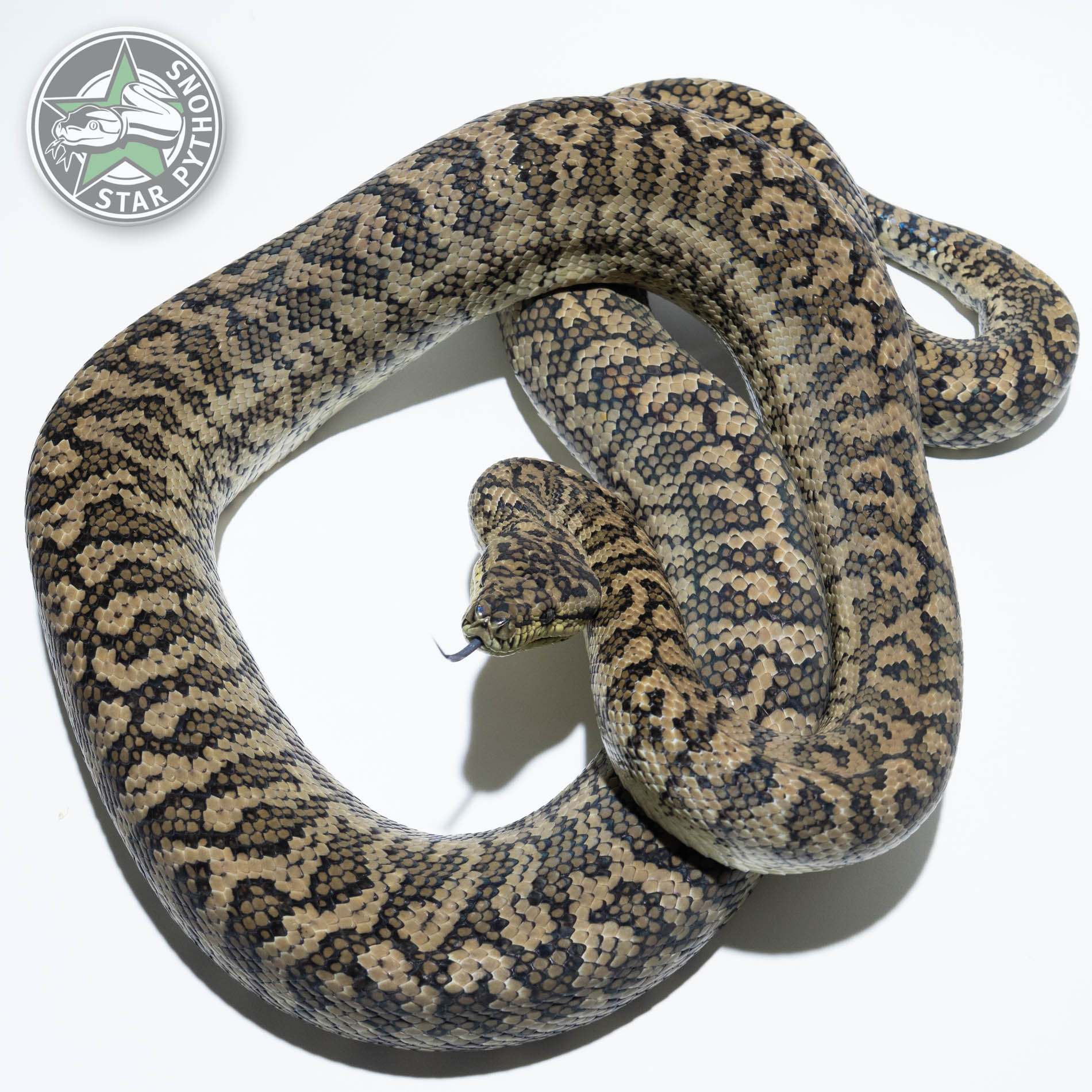
Zebra Jaguar Carpet Python (Morelia spilota) – Jungle × Coastal designer morph with bold fragmented cross-banding on vivid yellow

The Zebra Jaguar combines two intermediately inherited pattern mutations: Zebra from Jungle Carpet Pythons (M. s. cheynei) and Jaguar, which originated in Coastal Carpet Pythons (M. s. mcdowelli). The result is a designer cross where both mutations visibly influence the phenotype – the Zebra contributes its fine transverse banding while the Jaguar disrupts and fragments the dorsal pattern, creating a bold, open appearance with vivid yellow ground colour. The two pattern mutations interact differently in every individual, making Zebra Jaguars highly variable even within a single clutch. Because the contributing mutations originate in different subspecies, this is a documented cross and should be recorded as such.

Caramel Zebra

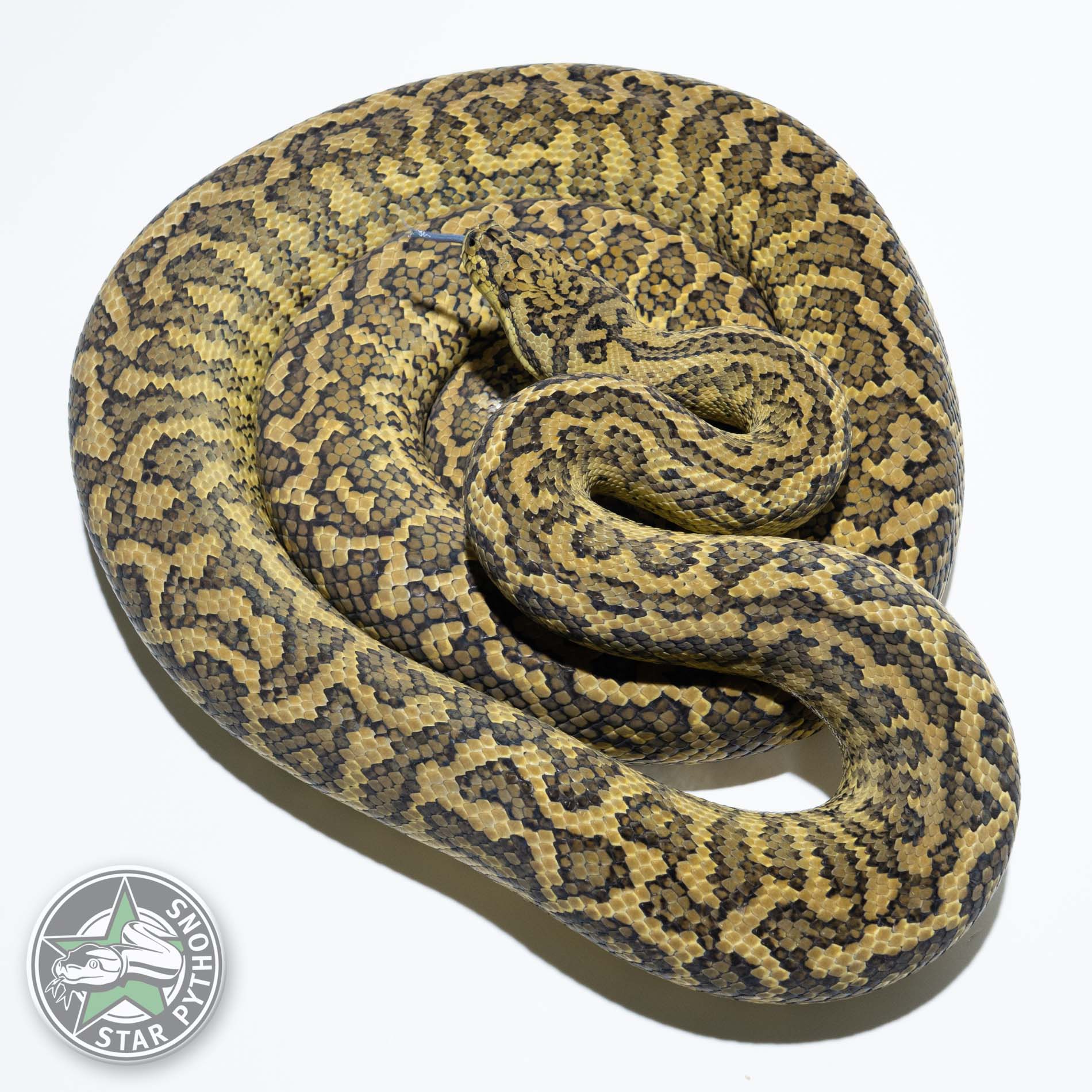
Caramel Zebra Carpet Python (Morelia spilota) – combination of intermediately inherited Caramel and Zebra with warm brown tones and softened banding

The Caramel Zebra combines the intermediately inherited Caramel colour mutation – originating in Coastal Carpet Pythons (M. s. mcdowelli) – with the Zebra pattern from Jungle lineages. The Caramel reduces dark melanin pigmentation and shifts the palette toward warm brown, bronze, and gold tones, softening the typical high-contrast black-and-yellow Zebra appearance into something warmer and more muted. The Zebra banding remains clearly visible but is expressed in earth tones rather than stark contrasts. This is a subspecies cross, as Caramel and Zebra originate in different subspecies. Super forms of both traits can be combined.

Hypo Zebra

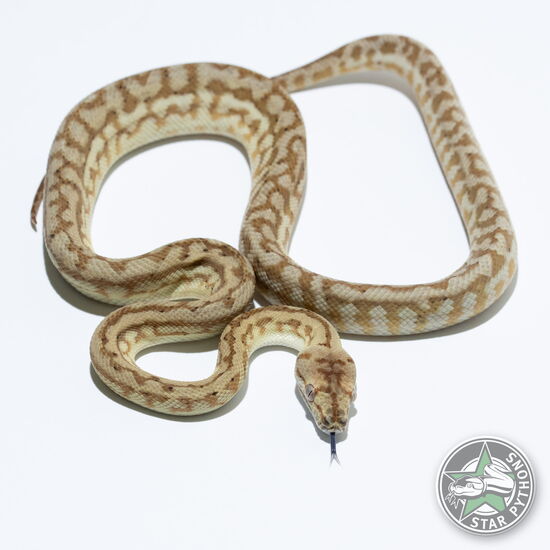
Hypo Zebra Carpet Python (Morelia spilota) – combination of Hypo melanin reduction and Zebra banding with lightened overall appearance

The Hypo Zebra combines the intermediately inherited Hypo (hypomelanistic) mutation with the Zebra pattern. Hypo reduces the overall expression of dark melanin, lightening the animal's appearance without eliminating dark pigment entirely. On a Zebra background, this creates a softer, more pastel version of the characteristic banding – the dark bands appear tan or light brown rather than black, while the ground colour shifts toward a lighter, more uniform yellow or cream. The combination is relatively uncommon compared to Caramel Zebra or Zebra Jaguar, but produces an elegant, understated look that develops well with age.

Hypo Zebra Jaguar

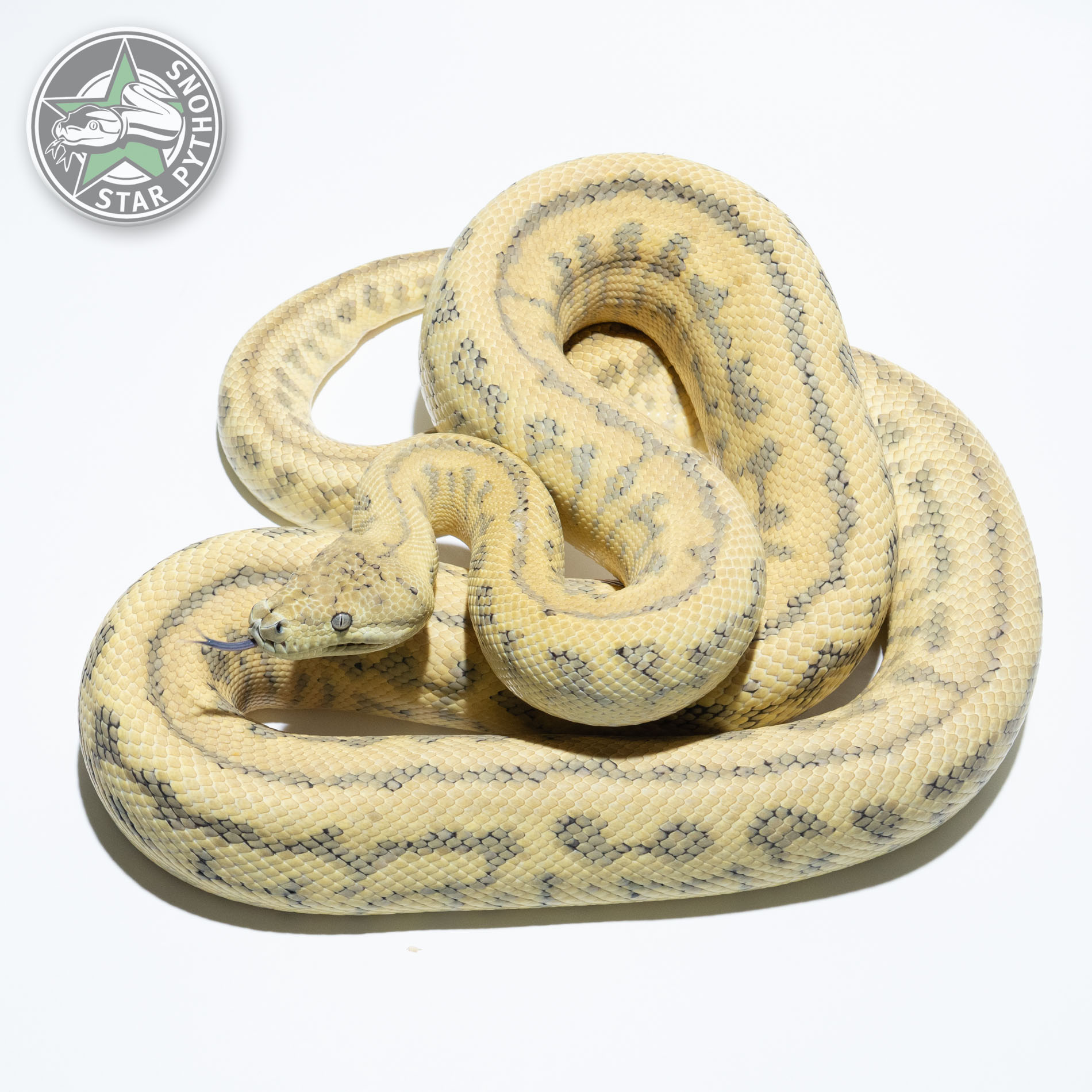
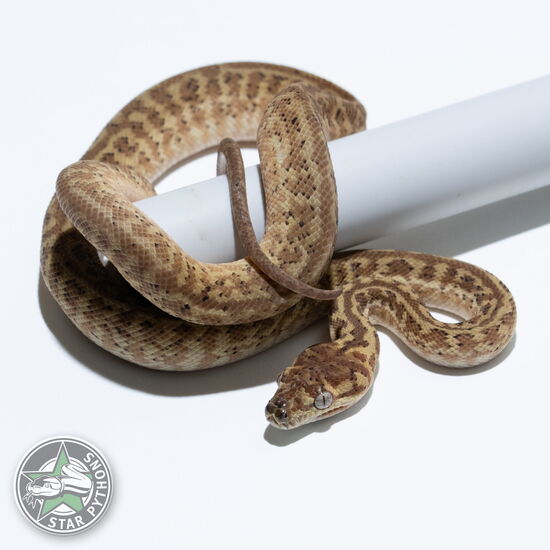
Hypo Zebra Jaguar Carpet Python (Morelia spilota) – triple incomplete dominant combination with softened contrast and warm ochre tones

The Hypo Zebra Jaguar is a triple combination of three intermediately inherited mutations: Hypo, Zebra, and Jaguar. The Hypo softens and lightens the overall melanin expression, the Zebra provides the fine transverse banding, and the Jaguar disrupts the dorsal pattern. The combined effect is a pale, cream-to-ochre animal with fragmented, softened pattern remnants – a striking departure from the bold black-and-yellow of a pure Jungle Zebra. Because Zebra originates in M. s. cheynei while Jaguar and Hypo come from Coastal (M. s. mcdowelli) backgrounds, this is a multi-subspecies designer combination.

Albino Zebra

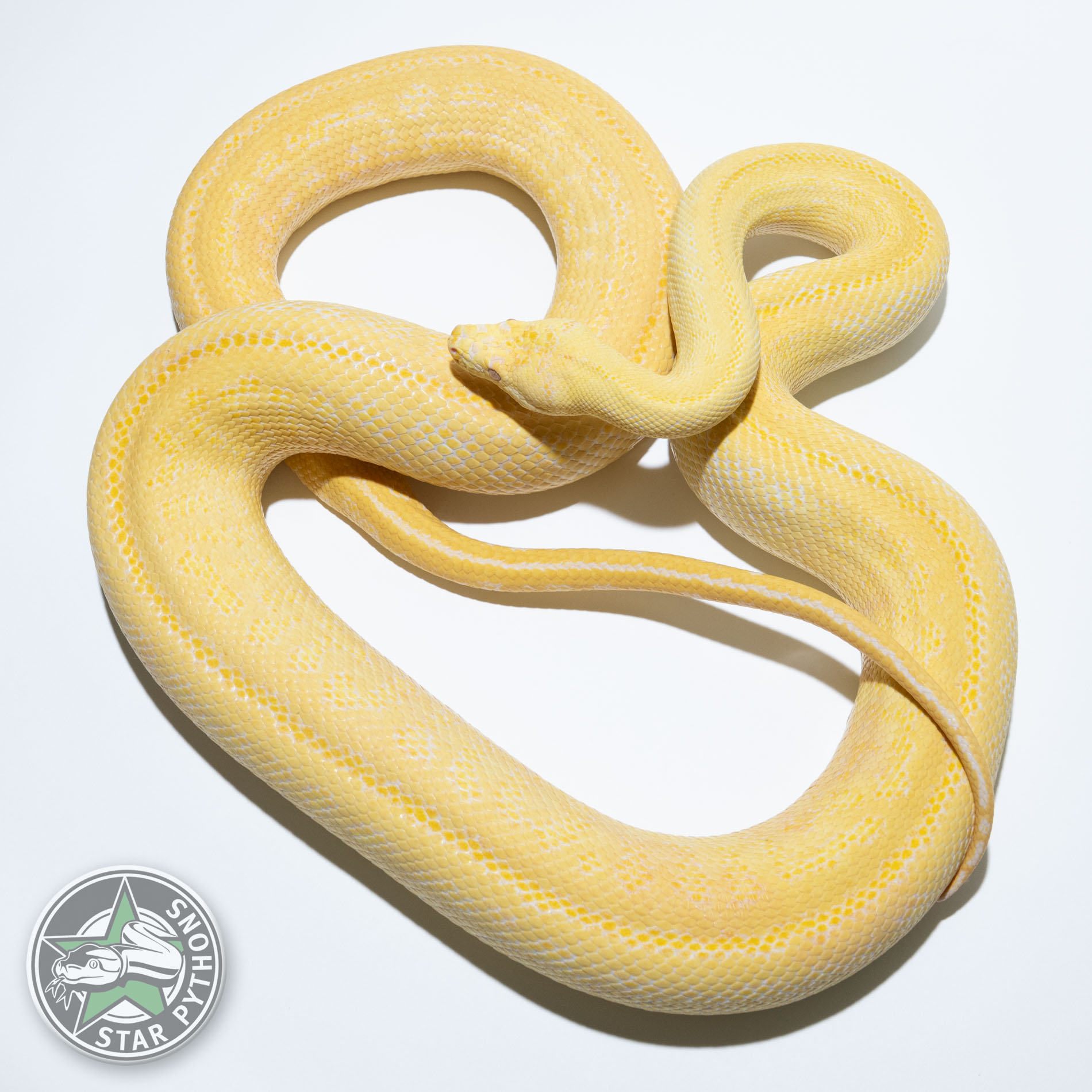
Albino Zebra Carpet Python (Morelia spilota) – amelanistic Carpet Python with bold striping

The Albino Zebra combines the recessive tyrosinase-negative (T−) Albino mutation – originating in Darwin Carpet Pythons (M. s. variegata) – with the intermediately inherited Zebra from Jungle lineages. Removing melanin entirely transforms the Zebra's characteristic banding from black-and-yellow into vivid yellow-and-white, creating one of the most visually dramatic morph combinations in the carpet python complex. The fine transverse striping of the Zebra is fully retained but expressed in amelanistic colours only. Because Albino and Zebra originate in different subspecies, this is a documented cross. The homozygous form – an Albino Super Zebra – produces a patternless animal in uniform yellow to white.

Axanthic Zebra

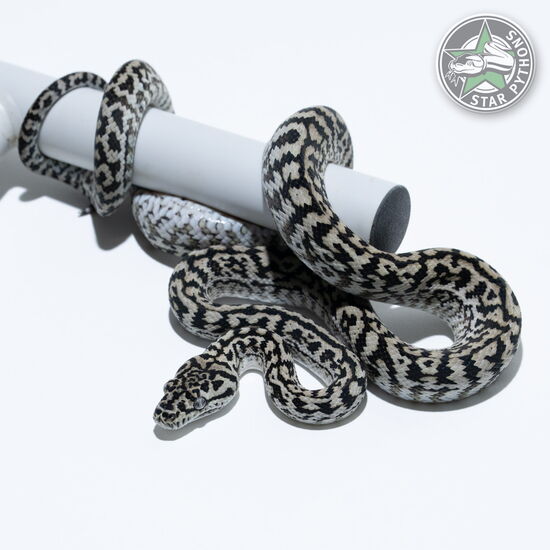
Axanthic Zebra Carpet Python (Morelia spilota) – recessive Axanthic combined with intermediately inherited Zebra producing crisp black and silver banding

The Axanthic Zebra combines the recessive Axanthic mutation – which strongly reduces yellow pigmentation – with the intermediately inherited Zebra pattern. The result pushes the Zebra's natural contrast to its logical extreme: crisp black banding on a clean silver-grey ground with virtually no residual warm tones. Axanthic Zebras are among the most graphically striking carpet python combinations available. The super form – an Axanthic Super Zebra – takes this further, producing a patternless silver-grey animal that is widely regarded as one of the most elegant expressions in the entire Morelia spilota complex. At StarPythons, we work with both Coastal and Papuan Axanthic lines in combination with Zebra.

Axanthic Super Zebra

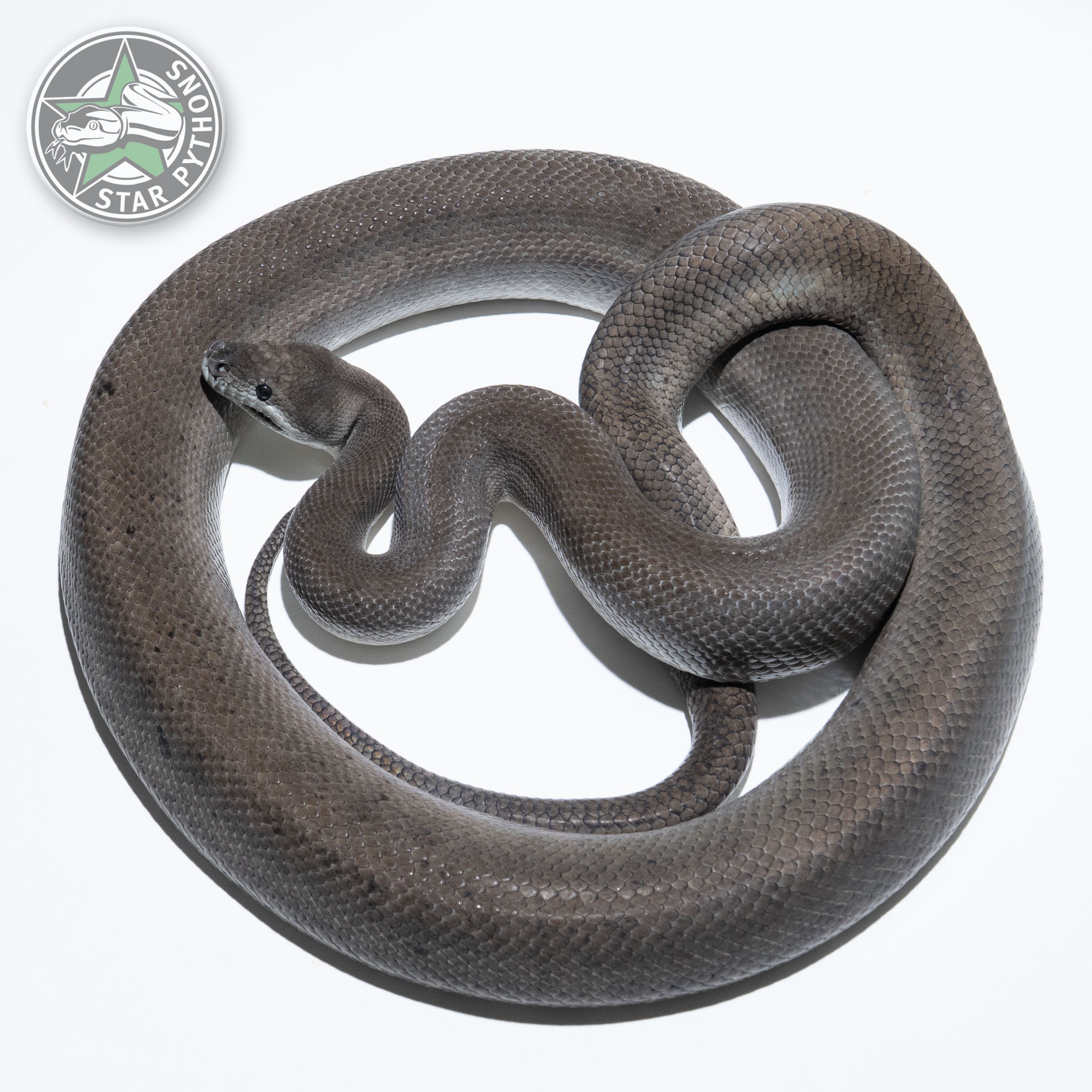
Axanthic Super Zebra Carpet Python (Morelia spilota) – homozygous Zebra on recessive Axanthic background producing a near-patternless silver-grey animal

The Axanthic Super Zebra is the homozygous Zebra form on an Axanthic background – an animal carrying two copies of the Zebra allele combined with the recessive Axanthic mutation. Where a pure Jungle Super Zebra appears as a near-patternless yellow animal, the Axanthic version replaces that yellow with a clean, uniform silver-grey. The result is one of the most elegant expressions in the entire Morelia spilota complex: a smooth, monochromatic animal with virtually no pattern and no warm tones. Producing an Axanthic Super Zebra requires both parents to carry at least one copy of the Zebra allele and both to carry the recessive Axanthic – making this a combination that demands careful multi-generation line planning. At StarPythons, we work with both Coastal and Papuan Axanthic lines, and the visual character of the Axanthic Super Zebra varies slightly depending on which Axanthic background is used.

Ghost Zebra

Ghost Zebra Carpet Python (Morelia spilota) – Hypo Axanthic Zebra combination with cool grey banding and desaturated tones

The Ghost Zebra combines Hypo (reducing melanin expression) and Axanthic (reducing yellow pigmentation) with the intermediately inherited Zebra pattern. "Ghost" is the established name for the Hypo-Axanthic double combination – the two colour-reducing mutations working together to produce a pale, desaturated animal. On a Zebra background, the fine transverse banding is retained but expressed in soft grey and silver tones with minimal residual warmth. The overall impression is a cool, muted animal with clean, graphic patterning – lighter and more washed out than a standard Axanthic Zebra. Ghost Zebras require the Hypo component (intermediately inherited) plus homozygous Axanthic (recessive), making production somewhat complex.

Caramel Axanthic Zebra Jaguar

Caramel Axanthic Zebra Jaguar Carpet Python (Morelia spilota) – quadruple combination morph with reduced pattern, desaturated tones and Jaguar pattern disruption

The Caramel Axanthic Zebra Jaguar is one of the most complex combination morphs we produce – a quadruple combination involving two intermediately inherited pattern mutations (Zebra and Jaguar), one intermediately inherited colour mutation (Caramel), and one recessive colour mutation (Axanthic). The Axanthic removes warm yellow tones, the Caramel reduces dark melanin, the Zebra provides its characteristic fine banding, and the Jaguar disrupts and fragments the pattern. The interaction of all four traits produces a pale, desaturated animal with subtle pattern remnants in cool grey and silver tones – an appearance that is difficult to predict and unique to each individual. This is a multi-subspecies designer combination involving genetics from at least three different Morelia spilota subspecies.

What Makes a Zebra?

The Zebra morph is a pattern mutation that fundamentally reorganises the scale-by-scale pigment distribution in carpet pythons. Where wild-type Jungle Carpet Pythons display bold, irregular dark markings on a yellow or gold background, Zebras show a fine, repetitive banding pattern – thin, parallel-running bands that give the animal its characteristic "pixelated" or striped appearance.

Key visual features that define a Zebra include the fine, high-frequency banding that replaces the normal dorsal pattern, the retention of high-contrast black-and-yellow colouration in pure Jungle backgrounds, and the distinctly different appearance of the homozygous Super Zebra – a near-patternless animal in a uniform base colour.

The Zebra pattern is visually distinct from Tiger striping. Where Tigers (M. s. mcdowelli) produce broad, longitudinal dorsal stripes, Zebras produce fine, transverse banding – the stripes run across the body rather than along it. The two morphs originate in different subspecies and interact differently with other mutations.

Biology and Genetics

The Zebra morph is classified as an intermediately inherited (often called "co-dominant" in the hobby) pattern mutation. This means that a single copy of the Zebra allele produces a visible phenotype (the heterozygous Zebra), while two copies produce a distinctly different homozygous phenotype (the Super Zebra). This is the same inheritance pattern seen in Jaguar and Caramel in the carpet python complex.

In genetic terminology, "intermediate inheritance" is more accurate than "co-dominance" for most reptile morphs. In true co-dominance, both alleles are fully expressed side by side. In intermediate inheritance – also called incomplete dominance – the heterozygous phenotype falls between the two homozygous extremes. The Zebra pattern in heterozygous animals represents an intermediate state: more patterned than a Super Zebra (homozygous), but with a fundamentally different pattern layout than a wild-type animal (homozygous normal).

The specific gene or genes underlying the Zebra mutation have not been identified through molecular analysis. The inheritance pattern is established purely through breeding data – consistent 1:2:1 ratios (normal : Zebra : Super Zebra) in Zebra × Zebra pairings, and 1:1 ratios (normal : Zebra) in Zebra × normal pairings.

Super Zebra and tail kinking: Early in the history of the morph, some Super Zebra animals were reported to have kinking in the tail. This issue has been observed primarily in pure cheynei Super Zebras without additional morph influence. Reports from breeders suggest that the kinking issue is significantly reduced or eliminated when the Super Zebra is produced in combination with a second morph – suggesting the kinking may be linked to background genetics rather than being a direct consequence of Zebra homozygosity. Nonetheless, this is a point worth monitoring in any Super Zebra breeding programme.

No neurological issues: Unlike the Jaguar mutation, the Zebra morph is not associated with neurological symptoms ("wobble") in either the heterozygous or homozygous form.

History of Zebra Carpet Pythons

The Zebra mutation first appeared in captive-bred Jungle Carpet Pythons (Morelia spilota cheynei) in a private collection in Europe. Paul Harris of UK Pythons acquired the original Zebra specimen – a unique-looking animal whose inheritability was unknown at the time. The previous owner had been unable to breed the animal successfully.

In 2003, Paul Harris bred the original Zebra male to a normal, unrelated Jungle Carpet female. Two of the six viable offspring showed the Zebra phenotype – confirming that the trait was heritable and consistent with a dominant or intermediately inherited mode of inheritance. In 2005, one of these F1 Zebras was bred to another unrelated Jungle female, again producing Zebra offspring. In 2007, the first Zebra × Zebra pairing was made, and from 11 eggs the first Super Zebras were produced – confirming the intermediate inheritance model and revealing the homozygous patternless phenotype.

Paul Harris subsequently developed a wide range of Zebra combinations at UK Pythons, including Caramel Zebras (first Zebra × Coastal Caramel cross in 2008), Super Caramel Zebras (2010), Zebra Granites (2010), Zebra Jaguars, and Albino Zebras. His breeding programme established the foundation stock that virtually all Zebra Carpet Pythons in the global hobby trace back to.

The first Zebras arrived in the United States in 2008, imported by Nick Mutton of Inland Reptile, who acquired two of the first animals to leave Europe. These animals and their offspring formed the basis of Zebra projects across the US.

At StarPythons, we have worked with Zebra Carpet Pythons since 2010 and maintain documented lineages across both pure Jungle Zebras and a range of designer combinations. Especially when combined with our "German Bloodline" Jungle Carpet Pythons – known for their deep black and bright yellow contrast – the Zebras produce breathtaking results.

Inheritance: Practical Expectations

Zebra follows a straightforward intermediate inheritance pattern, making breeding outcomes highly predictable:

Zebra × normal → statistically 50% Zebra offspring, 50% normal. All Zebras carry one copy of the allele.

Zebra × Zebra → statistically 25% Super Zebra, 50% Zebra, 25% normal. This is the classic 1:2:1 ratio. Super Zebras are visually identifiable at hatching due to their patternless or near-patternless appearance.

Super Zebra × normal → 100% Zebra offspring. Every animal inherits one copy of the allele from the Super Zebra parent.

Super Zebra × Zebra → statistically 50% Super Zebra, 50% Zebra. No normal offspring possible.

Super Zebra × Super Zebra → 100% Super Zebra offspring.

The practical takeaway: Zebra is among the most predictable pattern morphs in the carpet python complex. There is no guesswork about carrier status – Zebra is either visually expressed or absent. Super Zebras are immediately identifiable, and pairing outcomes follow textbook intermediate inheritance ratios.

Crossing into other subspecies: The Zebra mutation originated in Jungle Carpet Pythons (M. s. cheynei) but has been widely crossed into Coastals (M. s. mcdowelli), Papuans (M. s. harrisoni), Darwins (M. s. variegata), and various multi-subspecies designer combinations. In all cases, the Zebra pattern carries over and functions identically in the new genetic background. However, the visual expression – colour intensity, banding width, contrast – is influenced by the background genetics of the partner subspecies. Pure Jungle Zebras typically show the highest contrast, while crossed animals may display softer or warmer tones depending on the subspecies involved.

FAQ - Zebra Carpet Pythons

What is a Zebra Carpet Python?

The Zebra is an intermediately inherited pattern morph that originated in Jungle Carpet Pythons (Morelia spilota cheynei). It produces a distinctive fine banding pattern that replaces the typical wild-type markings. The morph has a homozygous "super" form – the Super Zebra – which is a patternless animal.

How is the Zebra morph inherited?

Zebra is intermediately inherited (often called "co-dominant" in the hobby). A single copy of the allele produces a visible Zebra phenotype; two copies produce a Super Zebra. Breeding two Zebras together yields approximately 25% Super Zebra, 50% Zebra, and 25% normal offspring.

What is a Super Zebra?

The Super Zebra is the homozygous form of the Zebra morph – an animal carrying two copies of the Zebra allele. Super Zebras are essentially patternless, displaying a uniform base colour. In pure Jungle backgrounds this is typically solid yellow; in Axanthic backgrounds, clean silver-grey.

Are there health issues associated with the Zebra morph?

The Zebra morph is not associated with neurological problems. Some Super Zebras show tail kinking, but this appears to be linked to background genetics rather than Zebra homozygosity itself, and is often absent in animals produced in combination with other morphs.

What is the difference between a Zebra and a Tiger?

Both are pattern morphs but they are visually and genetically distinct. Zebra originated in Jungle Carpet Pythons (M. s. cheynei) and produces fine, transverse banding; Tiger originated in Coastal Carpet Pythons (M. s. mcdowelli) and produces broad, longitudinal dorsal striping. Zebra is intermediately inherited with a super form; Tiger is polygenic with no super form.

Can Zebra be combined with other morphs?

Yes – Zebra is one of the most versatile pattern morphs in the complex. It combines well with Caramel, Jaguar, Albino, Axanthic, Granite, Hypo, and others. The fine banding of Zebra interacts differently with each colour and pattern mutation, producing a wide range of visual outcomes.

Who produced the first Zebra Carpet Pythons?

Paul Harris of UK Pythons acquired the original Zebra specimen and first proved the trait heritable in 2003. He subsequently proved the super form, developed numerous combination morphs, and established the lineage foundation that virtually all Zebra Carpet Pythons in the global hobby trace back to.

Is Zebra limited to Jungle Carpet Pythons?

The mutation originated in M. s. cheynei, but it has been widely crossed into other subspecies. Zebra functions identically in Coastal, Papuan, Darwin, and mixed backgrounds – though visual expression varies depending on the partner subspecies. Any cross between subspecies should be documented.

References

Harris, P. (2003–2010). Zebra Jungle, Super Zebra, Super Caramel Zebra – morph documentation. UK Pythons.

Mutton, N., & Julander, J. (2022). The more complete carpet python: A comprehensive guide to the natural history, care, and breeding of the Morelia spilota complex. ECO Publishing. ISBN 978-1-938850-42-4.
Available Zebra Carpet Pythons for Sale

Sex
Category
Morph
This beautiful female Hypo Zebra Jaguar carpet python with id 23-550 is for sale.
Animal ID: 23-550

Hypo Zebra Jaguar

900 € US$ 1,300 ₩ 1,499,000

Details

This beautiful male Hypo Zebra Jaguar carpet python with id 23-916 is for sale.
Animal ID: 23-916

Hypo Zebra Jaguar

900 € US$ 1,300 ₩ 1,499,000

Details

This beautiful female Hypo (pos Super) Zebra Jaguar carpet python with id 24-786 is for sale.
Animal ID: 24-786

Hypo (pos Super) Zebra Jaguar

1.000 € US$ 1,400 ₩ 1,699,000

Details

This beautiful male Hypo Zebra carpet python with id 24-738 is for sale.
Animal ID: 24-738

Hypo Zebra

600 € US$ 900 ₩ 1,299,000

Details

This beautiful female Ghost Zebra carpet python with id 24-442 is for sale.
Animal ID: 24-442

Ghost Zebra

1.900 € US$ 2,100 ₩ 2,899,000

Details

This beautiful male Zebra het Albino carpet python with id 25-176 is for sale.
Animal ID: 25-176

Zebra het Albino

225 € US$ 450 ₩ 599,000

Details