So you've done your research, debunked the myths, and decided to buy a carpet python (Morelia spilota) – congratulations! Whether you're setting up your first enclosure or looking to improve your current husbandry, this guide covers everything you need to know about keeping carpet pythons. We'll walk you through enclosure setup, substrate choices, lighting, heating, and humidity – all based on our experience breeding over 260 adult carpet pythons here at StarPythons in Germany.
Carpet Python Enclosures
When it comes to housing carpet pythons, the culture and legal requirements vary significantly between countries. Here in Germany, where StarPythons breeds all of our carpet pythons, there are laws regulating the minimum enclosure size for every reptile species. A carpet python measuring 2 meters (6.5 feet) requires a cage that is at least 0.5 × 0.5 × 0.75 times its total length – which translates to roughly 1 × 1 × 1.5 meters (3.25 × 3.25 × 4.9 feet). This effectively rules out any standard rack system for adult animals.
Is it possible to keep adult carpet pythons in racks? Technically, yes – and many breeders in the USA do so successfully. But carpet pythons are semi-arboreal snakes that will climb whenever given the opportunity, and a CB70 tub simply doesn't offer the vertical space these animals need to display their natural behavior. If you want an active, impressive display animal rather than a snake you rarely see, investing in a proper enclosure makes all the difference.
Hatchling Enclosures & Rack Systems
While we don't recommend rack systems for adult carpet pythons, housing hatchlings in small plastic bins is standard practice and works well. Placing a baby carpet python in a large adult enclosure often leads to stress and feeding problems – the animal simply feels too exposed.
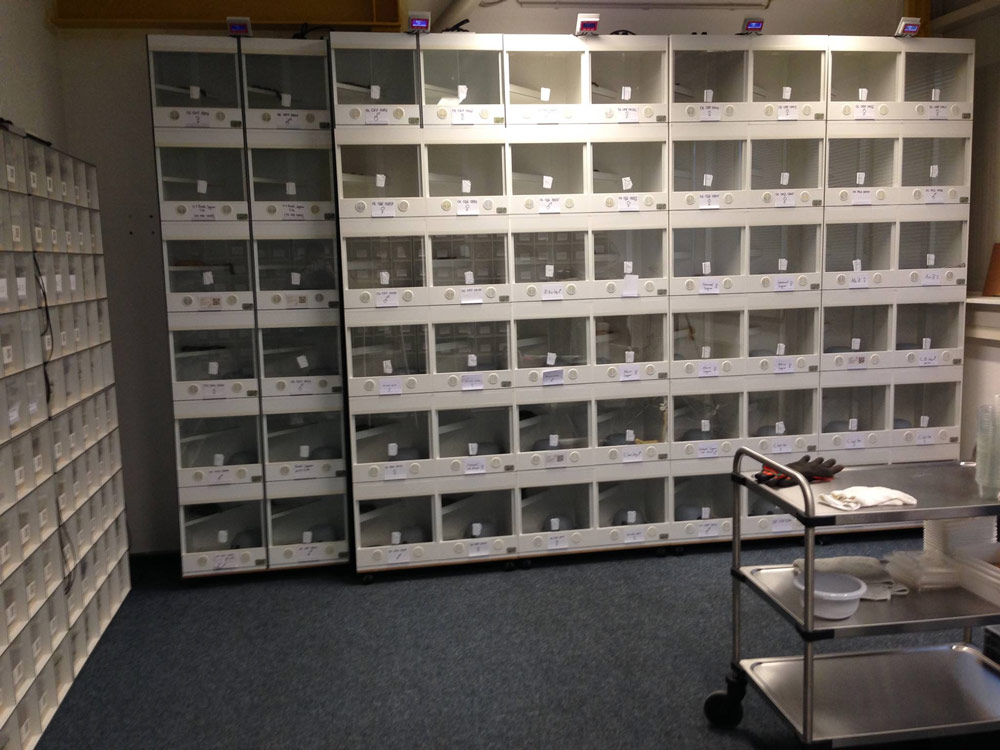
At StarPythons, we keep hatchlings in plastic bins measuring approximately 20 × 20 × 20 cm (7.8 × 7.8 × 7.8 inches). Each row in our rack has a heat mat operating at 30 °C (86 °F) on the bottom, controlled by a thermostat. The ambient room temperature is maintained at around 27 °C (80–81 °F). Every bin is equipped with a small perch for climbing.
Subadult & Juvenile Enclosures
As your carpet pythons outgrow their hatchling bins, they need an intermediate setup before moving into full-sized adult cages. This is particularly relevant for animals you plan to hold back for your own breeding program. At StarPythons, we house subadult and juvenile carpet pythons in PVC cube enclosures measuring 40 × 40 × 40 cm (16 × 16 × 16 inches). These cubes bridge the gap between small hatchling bins and large adult enclosures, giving the growing animals significantly more space without overwhelming them.
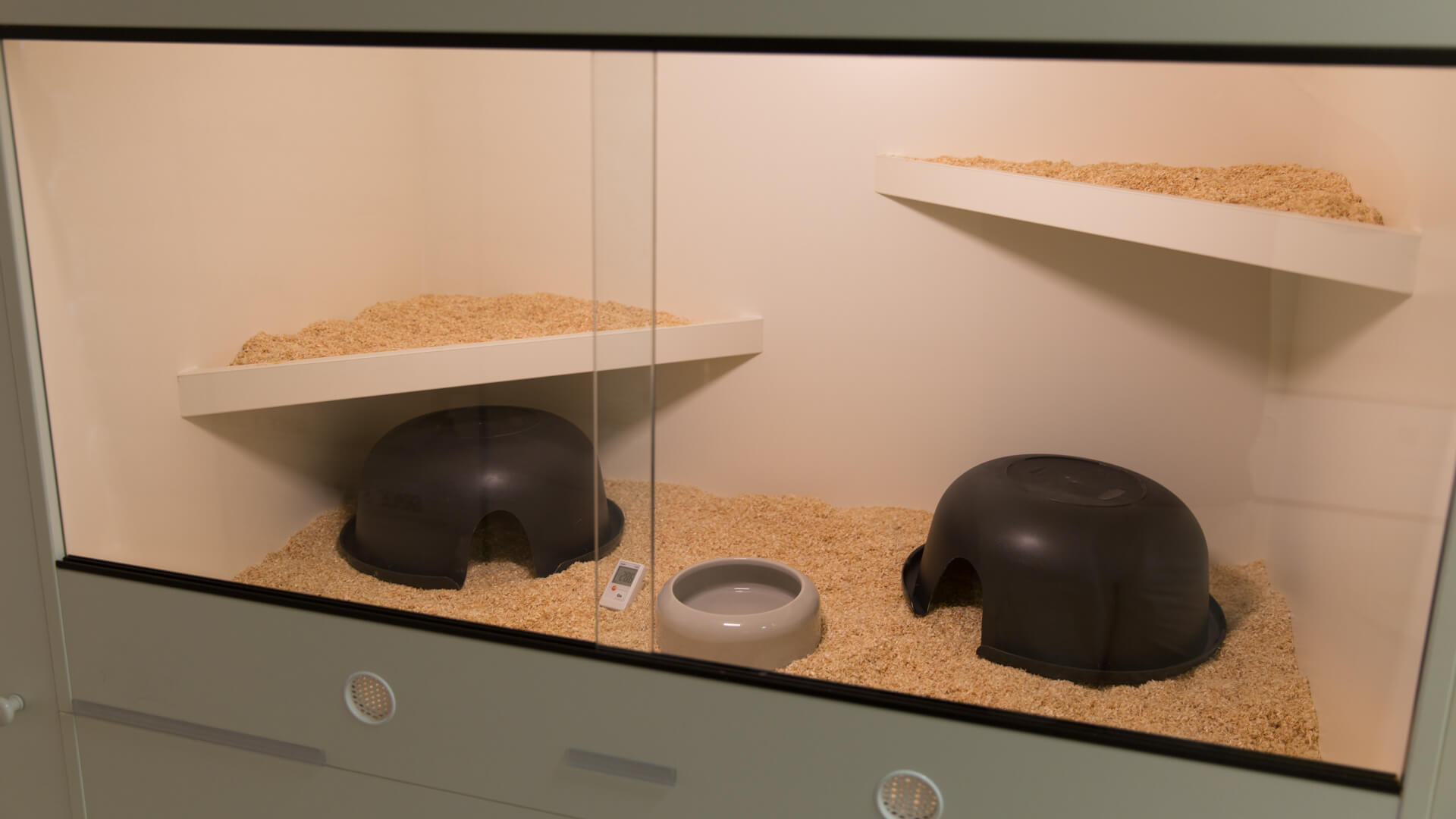
Each cube features a platform at mid-height, which carpet pythons love to use as an ambush perch – a behavior you'll see frequently once the animals settle in. The floor heating is regulated to 31 °C (88 °F) via thermostat. At this enclosure size, we use small water bowls that are refilled with fresh water daily.
For substrate, we use paper towels rather than loose bedding. Removing softwood granulate or similar substrates from a cube this size turned out to be extremely impractical in day-to-day maintenance. Paper towels are hygienic, quick to replace, and look considerably cleaner than newspaper.
Since the cube offers noticeably more space than a hatchling bin, the animals benefit from an additional hide. We use small plastic washing-up bowls repurposed as caves – simply cut a half-circle into one side and flip the bowl upside down. This solution is not only cheap and effective but also easy to keep clean. The bowls can be washed by hand or even run through a dishwasher, which makes them ideal for maintaining the hygiene standards required in a larger collection.
Adult Carpet Python Cages
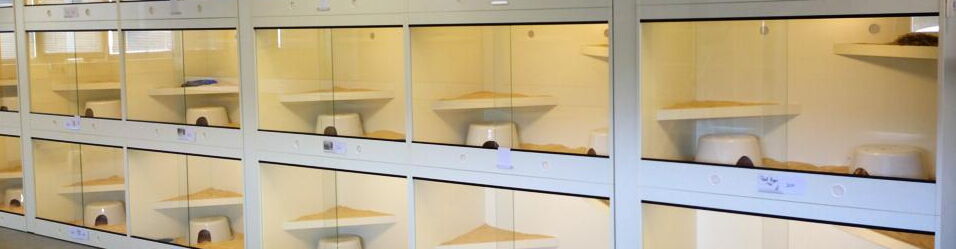
Our adult enclosures at StarPythons measure 120 × 70 × 80 cm (4 × 2.3 × 2.6 feet) and include two platforms at different heights. Each platform is large enough for a full-sized carpet python to rest on comfortably, and is covered with substrate. Since we maintain up to 120 adult cages per room, we heat the entire room to 27 °C (80–81 °F) and use ceiling fans to ensure even temperature distribution – otherwise, upper-level cages can run significantly warmer than floor-level ones.
Each cage contains an oval, waterproof heating mat (28 × 56 cm (11 × 22 inches), 40 watts) connected directly to a thermostat sensor, so the thermostat display shows the actual surface temperature of the mat. Never operate any heat source without a quality thermostat. Our heat mats are set to 36 °C (97 °F), providing a warm basking spot the snake can use at will.
Every cage also has two hide boxes – one positioned directly above the heating mat, the other on the cool side. Together with the two platform levels, this setup creates an effective temperature gradient that allows each carpet python to choose the temperature it needs at any given time. A solid, tip-proof water dish sits in the center of each cage.
Cage Materials – What Works Best
Any non-porous material works for building a carpet python enclosure, but easy cleaning should be a priority. Here's what we've found works well:
Melamine-faced chipboard is what we use at StarPythons. The white surface makes it easy to spot any dirt immediately. Important: never use unsealed chipboard, as adhesive fumes from the manufacturing process may be harmful to carpet pythons. If using sealed chipboard, apply silicone to all joints and gaps to prevent moisture from penetrating the wood.
PVC or polyethylene enclosures offer similar ease of cleaning as melamine-faced chipboard but are considerably lighter. These are an excellent option for keepers who need to move or stack enclosures.
Glass terrariums release heat very efficiently, which makes temperature control more difficult and energy-intensive. They can work, but insulated materials are generally the better choice.
Substrate for Carpet Pythons
We use a softwood granulate in all our enclosures. While carpet pythons in the wild certainly don't think about what's on the ground when they strike at prey, softwood granulate offers a practical advantage in captivity: if a snake misses its target and accidentally bites into the substrate, softwood won't cause any harm. We've seen carpet pythons eat rodents covered in softwood granulate and digest them without any issues.
Other popular substrate options include cypress mulch, which is widely available in pet shops and works well, or aspen shavings, which absorb odors effectively. Newspaper is another common choice, but after using it for several years, we moved away from it. You can't spot-clean newspaper – you always have to replace the entire sheet. It's also harder to see dirt, it doesn't absorb fluids well, and frankly, it's more labor-intensive than loose substrate.
Lighting for Carpet Pythons
At StarPythons, we use LED tubes with a color temperature of 6,500 Kelvin (daylight) in all cages and rooms. All lighting is connected to a timer. During summer months, lights run from 8:00 AM to 8:00 PM. In winter, the schedule shifts to 9:00 AM – 5:00 PM, simulating the natural seasonal change in photoperiod.
Do Carpet Pythons Need UVB?
Carpet pythons don't strictly require UVB lighting to survive in captivity, and we don't use dedicated UVB bulbs in our breeding facility. However, UVB does no harm and may enhance the colors of your snakes. Some keepers and veterinarians increasingly recommend low-level UVB (5.0–7.0 T5) for overall health benefits. If you choose to add UVB, make sure it doesn't interfere with your heating setup.
One important note: we deliberately keep lighting and heating separate. If you combine them (for example, by using a heat bulb as your primary light source), the light will switch off whenever the thermostat reaches the target temperature – leaving your snake in the dark during the day.
Heating & Temperature
Correct temperatures are essential for the health of your carpet pythons. You need both a proper ambient temperature and a dedicated basking spot to create an effective temperature gradient inside the enclosure. Keep in mind that temperature preferences can vary slightly between carpet python subspecies.
Recommended Temperature Ranges
Daytime
Nighttime
Ambient temperature (Summer)
27 °C (80–81 °F)
25 °C (77 °F)
Ambient temperature (Winter)
25 °C (77 °F)
20 °C (68 °F)
Basking spot
36 °C (97 °F)
30 °C (86 °F)
We maintain a basking spot even at night. In the wild, carpet pythons will rest on warm rocks that retain heat from the day – our heating mat serves the same purpose. The snakes don't have to use it, but they can if they need to.
Setting Up a Temperature Gradient
If you have a dedicated reptile room, the simplest approach is to heat the entire room to 27 °C (80–81 °F) and add a heat mat to one side of each cage. Use ceiling fans to distribute heat evenly, especially if you have cages stacked at different heights.
If a dedicated room isn't an option, you'll likely need more than one heat source per cage, depending on your enclosure material. Thick chipboard insulates far better than glass. Here's a setup that works well:
Place a heating mat on one side of the cage floor – this is your basking spot at 36 °C (97 °F). Then, offset slightly toward the center of the cage and install a ceramic heat emitter above the mat area. Always protect ceramic heaters and heat bulbs with a wire guard – a carpet python that wraps around an unprotected heater can suffer severe burns.
Ideally, use a thermostat with two sensors: one attached directly to the heating mat surface, and the second positioned in the center of the cage near ground level, set to your target ambient temperature of 27 °C (80–81 °F). This way, you maintain a constant basking spot on one side, the correct ambient temperature in the middle, and a slightly cooler zone on the opposite end. The snake can thermoregulate by moving between these zones.
Avoid setups with only a single heat source. If the basking spot is your only heat source, it will switch off as soon as the ambient thermostat reaches the target temperature – leaving the snake without a warm retreat.
Humidity for Carpet Pythons
Carpet pythons are not particularly demanding when it comes to humidity, but maintaining reasonable levels contributes to healthy shedding and overall well-being. A relative humidity of 40–60 % works well for most carpet python subspecies. Morelia bredli from the arid interior of Australia tends to do better at the lower end of that range (30–50 %).
In our facility, the water dishes in each cage provide sufficient ambient humidity. If you notice your snake having difficulty shedding (retained shed or patchy sheds), you can increase humidity by misting the enclosure lightly or adding a humid hide – a small enclosed space lined with damp sphagnum moss. Allow the enclosure to dry out between mistings to prevent bacterial growth.
Monitor humidity with a digital hygrometer placed in the middle of the enclosure. Over-misting and poor ventilation are more common problems than low humidity with carpet pythons.
Cage Cleaning & Disinfection
Maintaining a clean enclosure is just as important as getting the setup right. In the video below, StarPythons founder Philip Starcky – who holds an M.Sc. in infection biology with a specialization in reptile virology – walks you through our three-tier cleaning protocol: daily spot cleaning, scheduled deep cleaning, and the more intensive outbreak protocol required when dealing with pathogens like viruses. He also explains the science behind common disinfectants, including why 70 % isopropyl alcohol outperforms 99 %, how active oxygen disinfectants work, and what contact times are actually needed to be effective.
FAQ - Carpet Python Enclosures & Setup
What is the best cage material for carpet pythons?
Any non-porous material that is easy to clean will work. We use white melamine-faced chipboard at StarPythons because dirt is immediately visible on the light surface. If you choose sealed chipboard, make sure to apply silicone to all joints to prevent moisture from soaking into the wood – and never use unsealed chipboard, as adhesive fumes may be harmful. PVC and polyethylene enclosures are excellent lightweight alternatives that are equally easy to disinfect. Glass terrariums can work but lose heat quickly, making temperature control more difficult and energy-intensive.
How do I set up a temperature gradient in a carpet python enclosure?
Place a thermostat-controlled heating mat on one side of the cage floor to create a basking spot at 36 °C (97 °F). If you can't heat the entire room to your target ambient temperature of 27 °C (80–81 °F), add a ceramic heat emitter slightly offset toward the center of the cage – always protected by a wire guard to prevent burns. Use a dual-sensor thermostat: one probe on the heating mat surface, the other at ground level in the center of the cage. This gives you a constant basking zone on one side, the correct ambient temperature in the middle, and a cooler retreat on the opposite end. The snake can then move freely between zones and thermoregulate on its own.
When should I move my hatchling carpet python to a larger enclosure?
There is no fixed age – it depends on the individual animal's size and feeding confidence. At StarPythons, hatchlings start in small bins of approximately 20 × 20 × 20 cm (8 × 8 × 8 inches). Once they are feeding reliably and have outgrown the bin, we move them to intermediate PVC cubes measuring 40 × 40 × 40 cm (16 × 16 × 16 inches) with a mid-level platform, floor heating, and an additional hide. They stay in these subadult setups until they are large enough for a full adult enclosure. The key at every stage is to provide enough cover and hides so the animal feels secure – a snake that feels exposed in a too-large enclosure is more likely to refuse food and become stressed. Looking for hatchlings to start with? Check our available carpet pythons.
What substrate is best for carpet pythons – wood chips, paper, or mulch?
All three can work, but each has trade-offs. We use softwood granulate for all adult enclosures because it is safe if accidentally ingested during a feeding strike, easy to spot-clean, and absorbs fluids well. Cypress mulch is a widely available alternative that performs similarly. Newspaper is cheap but harder to spot-clean, doesn't absorb liquids effectively, and needs full replacement every time. For our subadult cubes, we actually prefer paper towels – removing loose substrate from a small enclosure is impractical, and paper towels are hygienic, quick to swap, and more aesthetically pleasing than newspaper. Choose based on your enclosure size and maintenance routine.
Should I separate lighting and heating in a carpet python cage?
Yes – we strongly recommend it. If your primary light source also serves as your heat source, the light will switch off whenever the thermostat reaches the target temperature. That means your carpet python could be sitting in the dark in the middle of the day, which disrupts its day-night cycle. At StarPythons, we use LED tubes at 6,500 Kelvin on a timer for lighting and separate heating mats controlled by independent thermostats for heat. This way, the photoperiod stays consistent regardless of what the heating system does.